Shopping cart 0 items
Donate
Member Login

Search form

Share
Login
Home
  • About
    • Mission
    • History
    • Masthead
    • Board of Directors
    • Contact
    • Privacy Notice
    • FAQ
    • Internships
  • Articles
    • Current Articles
    • Collections
      • Interviews
      • Narrative
      • History
      • Technology
      • Criticism
      • Other
    • Print Archive
    • Write for SP
  • Announcements
    • General
    • Classified
    • Events
    • Newsletter
  • Become a Member
  • Grants for Apprenticeships
  • Donate
    • Underwriting
    • Donate
    • Partners
  • Store
Book Review: Beyond Short Street, by Owen Rye.

Book Review: Beyond Short Street

Elaine Olafson Henry

At an age where the candles no longer fit on the birthday cake, an autobiography may be looked at as pure nostalgia. I prefer to regard it as review. How did I get here? Let me think about that for the next few hundred pages. – Owen Rye

The scenes described in this warmly written, sensitive, and engaging memoir could have taken place in any small town during this era. But ceramicist Owen Rye brings his reality to life for us as he fondly and not-so-fondly describes the people, places, and experiences that have influenced his rich and illustrious – albeit humble – life. Sprinkled with facts, observations, self-deprecating comments, acknowledgments of mistakes, descriptions of love and loss, and lots of questions, I found this memoir to be an easy read and an engaging journey. But as Owen begins the book, he reminds the reader that “this is not a book about ceramics.” It is about his life and how he coped with “changes and diversions, large and small, planned or entirely unimagined, and how one person dealt with all of that.”

With a current population of about 900 and much smaller back then, Owen’s hometown of Berridale could be transplanted almost anywhere in the Western world. On the experiences of his upbringing, he reminisces: “One advantage of being a child of the whole town was to go almost anywhere and receive a friendly word.” There were some dangers: “being bitten by a snake, chased by a bull, or accosted by a few local child bullies,” but there were more townsfolk who looked after him than endangered him. He could identify who drove by because of the sound of the individual vehicles, which changed as the town grew. 

In Berridale, a rural town, the milk came from a cow, and the bread came from the baker’s: “Hot bread was placed outside George Daniel’s bakery door at four am along with a money tin for payment. Nobody considered the money might be stolen.” Owen expresses more warm appreciation for local characters: “My mother kept almost everything that came into the house, . . . Each time she filled a shed to overflowing, my father built a new shed.” He relates a story about an eccentric local farmer, another “collector” of objects. “In the 1970s, he bought the remains of an old Land Rover from my brother. When I asked him what he was going to do with the small pile of junk, he said: ‘It might be good for something even if it’s no use for anything.’”
...
Read more

More from this issue

October 2022

Adamah wood-fire kiln
Fourteen Cords, Thirteen Cones, and All That Jazz
By Katherine Fischer
It was a moment in time, at a remote place in the middle of the rural Midwest USA, where three potters from far apart streams segued into one river. Before the current era of divisiveness, before the great illness that plagued the planet, beyond neighbor fighting neighbor, and before the world began to split apart, these potters, Joy Brown, Ching-Yuan Chang, and Ken Bichell, brought gifts of clay, fire, and spirit.
Read More
Marinobel Smith and the Pan-American Ceramic National
By Carolyn Herrera-Perez
This month's FREE article. This was the largest exhibition of the medium at the time, the first Pan-American survey of contemporary ceramics, and it remains one of few US exhibitions that tried to characterize the varied approaches of Latin American ceramists. With seventy pieces of modern ceramics from the region, organizers assembled impressive examples made by leading artists; to name only a few, these included Marina Nuñez del Prado, the internationally acclaimed modernist sculptor from Bolivia; Diana Chiari de Gruber, who founded the National Pottery School in La Arena, Panama; the Paraguayan ceramist Campos Cervera who signed his work under the pseudonym Julián de la Herrería, and his wife, the Spanish-born Paraguayan artist and cultural influencer Josefina Plá. What follows is a layered story about Latin America’s influence on US studio ceramics before the post-war era.
Read More
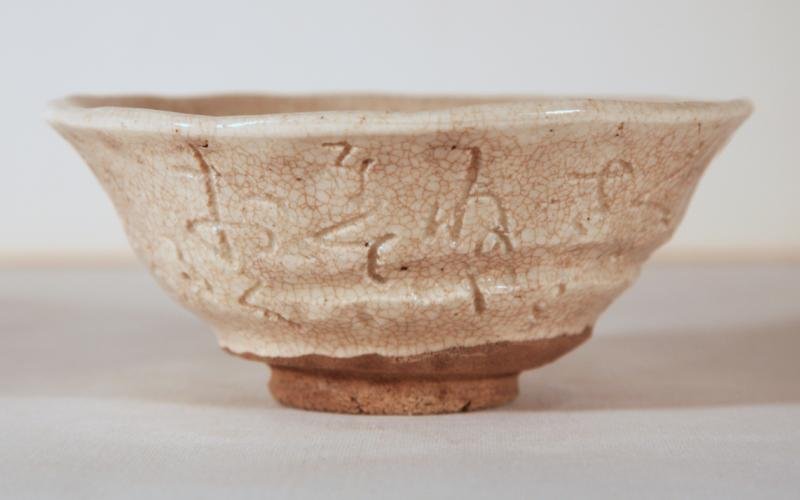
Otagaki Rengetsu: Tea bowl with incised poem. Glazed stoneware, 19th century. Collection of John Fong.
Ōtagaki Rengetsu: Poet, Potter, Nun
By Andrew L. Maske
The nun-potter Ōtagaki Rengetsu (1791-1875) is widely considered to be one of Japan’s most remarkable women. Along with emperors, military leaders, and notable men of culture, she is among those portrayed in Kyoto’s Festival of the Ages (Jidai matsuri) each autumn. Despite her preliminary objections, collections of her poetry were published during her lifetime, and countless people in the Kyoto region visited her little hut to pester her for examples of her pottery and calligraphy.
Read More
Back to Issue

Author Bio

Elaine Olafson Henry

Elaine Olafson Henry is a ceramics artist, curator, writer, and local volunteer. She earned a BFA at the University of Wyoming in 1992, an MFA from Southern Illinois University at Carbondale in 1995, and an MA in English from the University of Wyoming in 2020. Henry taught at Emporia State University in Kansas from 1996 through 2007, where she served as the Chair of the Department of Art from 2000 through 2007. 
She served as the President of the International Ceramics Magazine Editors Association (ICMEA) from 2014 to 2016 and the National Council on Education for the Ceramic Arts (NCECA) from 2002 to 2004. She is currently an Honorary Member and a Fellow of NCECA, a Lifetime Member of ICMEA, and now serves on the Council of the International Academy of Ceramics. 
Henry is the former Editor and Publisher of the international ceramics journals Ceramics: Art & Perception and Ceramics TECHNICAL. 
Henry has curated, juried, lectured, demonstrated, and taken part in residencies in more than 10 countries. Her work is internationally published, exhibited, and collected. 

Website

CONTACT  |  NEWSLETTER SIGNUP  |  COPYRIGHT © 2026 STUDIO POTTER  |  SITE DESIGN

Design by Adaptive Theme

Member Log in

  • Create new account
  • Reset your password
Forgot your password?
Continue as Guest
Become a Member
Library IP Login