Shopping cart 0 items
Donate
Member Login

Search form

Share
Login
Home
  • About
    • Mission
    • History
    • Masthead
    • Board of Directors
    • Contact
    • Privacy Notice
    • FAQ
    • Internships
  • Articles
    • Current Articles
    • Collections
      • Interviews
      • Narrative
      • History
      • Technology
      • Criticism
      • Other
    • Print Archive
    • Write for SP
  • Announcements
    • General
    • Classified
    • Events
    • Newsletter
  • Become a Member
  • Grants for Apprenticeships
  • Donate
    • Underwriting
    • Donate
    • Partners
  • Store
One early morning at the shrine in Minneapolis. Photo credit: Judy Griesedieck

What I See from My Window

Keith Luebke (he/him/his)

This spring, the windows of my new workspace will open for the first time. That moment will come after a winter of cold winds, pandemic adaptations, and hard work. The space is not large, but it is more than adequate. I'm an aging potter, and a recent move led to less clutter in a new space. Working here feels liberating and hopeful. Most importantly, I left my basement studio behind. Now, I have windows. Windows are almost always good, but when you hope to have more time for studio work, they become a special feature – one of architecture's most impressive gifts.

As I was remodeling the workspace and moving at the same time, there was a growing rebellion after the murder of George Floyd. My home is just over an hour away from Minneapolis, and I know the Minneapolis neighborhoods where Floyd was killed. Eight blocks to the north of what has become George Floyd Square is the Global Market – home to dozens of locally-owned, diverse businesses. It is just over two miles from Global Market to Northern Clay Center (NCC). I can drive from one to the other in ten minutes or so. 
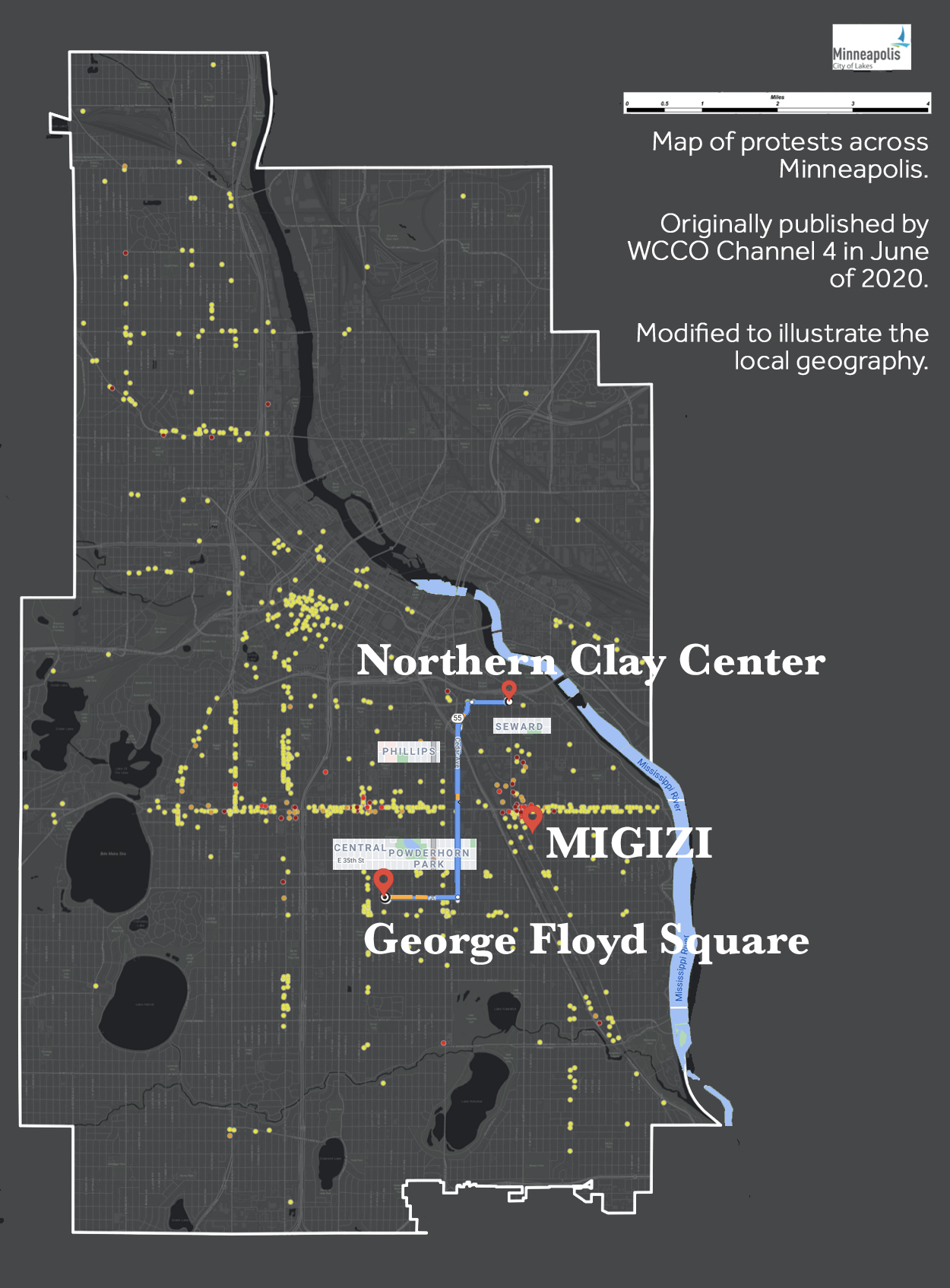
The neighborhoods are familiar to my partner and me. As teachers, every hour, every day immersed in this sort of diversity is a gift. That gift can always find a way back to the classroom, into the lives of students, and to our home community. Many are tired of the word diversity. For too many, it brings to mind ineffective workshops, repetitiveness, and the sound of established voices explaining things to us. That is why immersion works best. Let the neighborhoods talk. I have waited for someone to discuss the murder of George Floyd in the journals I read, and I have waited for substantive responses from the organizations and institutions we move within and between. But at some point, there needs to be a place for all of us to jump in. For me, this is that place.

Phillips, Powderhorn, and Longfellow neighborhoods are clustered together in Minneapolis south of Interstate 94. Drive farther east into St. Paul, and you will pass through what used to be a vibrant Black community – the Rondo neighborhood. The decision to let I-94 cut through and destroy the Rondo business district during the late 1950s remains an unmistakable symbol of racism – many other American cities used the same tactic. The highways and streets of our nation are built and maintained on a racist foundation, and it shapes our neighborhoods.


...
Read more

More from this issue

May 2021

Connection in Clay
By Charlotte Sleeper
I found a bat with her handprint on it. It was a bit uncanny – just how perfect it was. I keep it right above my wheel, leaned on a little ledge of brick. She was and will forever be fundamental to my connection to pottery. I know my grandmother would be proud of the potter I am today.
Read More
Out of the Blue, Into the Black (Vulture)
By Hayne Bayless and Mara Lavitt
She apparently needed us, but so did we need her. She was earthbound, and, like us in our pandemic prison, unable to go far. But if she could break free, then perhaps so could we shed ourselves of this hermetic existence and return to our kettle.
Read More
The Tulip Tree
By Harrison Levenstein
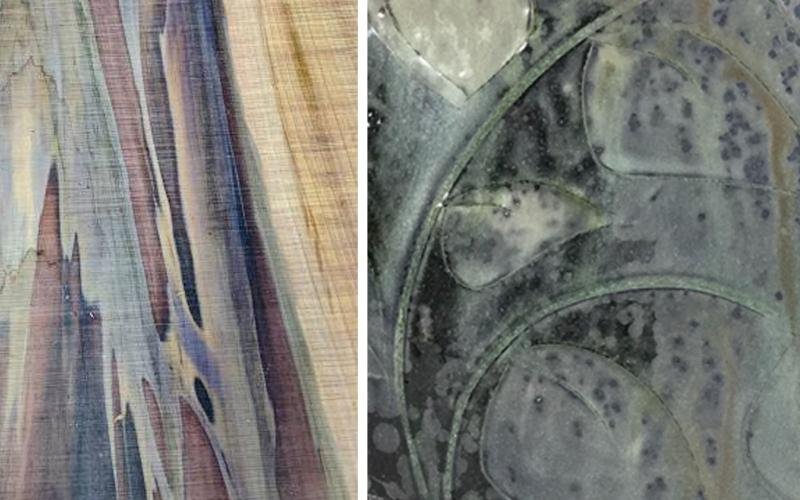
Deeper inside the tree, a wine-dark sea of grain fading to a gentle indigo, lavender, and deep green make up the heartwood. The wide range of color in melted ash surfaces that can be seen at the unloading of a wood kiln are continually surprising. I’ve found myself thinking, “How can such color come from simple wood ash?” Well, it seems it had been in there all along.
Read More
Touching the Soil
By Elçin Telli
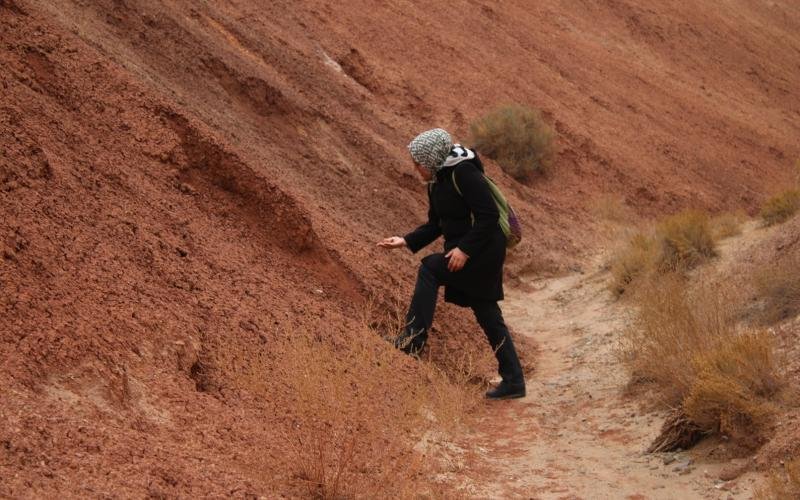
Touch – not touch as we know it, but touch defined by adding something to soil with my effort, my touch. From this point of view, I have touched the soil of Iğdır.
Read More
Back to Issue

Author Bio

Keith Luebke (he/him/his)

Keith Luebke is a retired teacher with two degrees in art, one in sociology, and one in urban studies. He worked in a variety of nonprofit organizations for nearly twenty years. That work included promoting craftspeople in rural Illinois and New Mexico, but most of his work was with people experiencing homelessness. Keith was a part-time grant writer from the 1980s into this new millennium. He wrote funding proposals to create housing and supportive services for low-income families and individuals. 

CONTACT  |  NEWSLETTER SIGNUP  |  COPYRIGHT © 2026 STUDIO POTTER  |  SITE DESIGN

Design by Adaptive Theme

Member Log in

  • Create new account
  • Reset your password
Forgot your password?
Continue as Guest
Become a Member
Library IP Login