

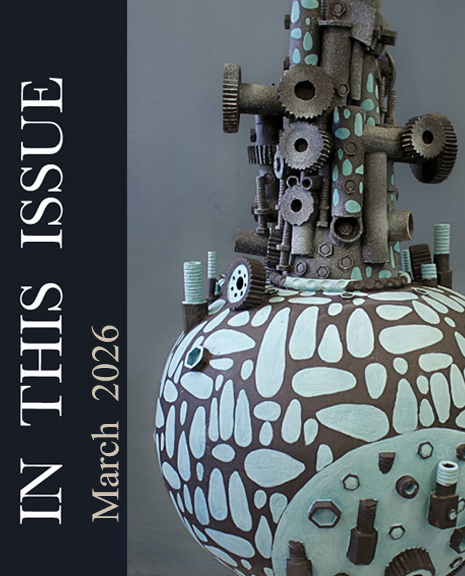
 When stories of African and international art are written, often the analysis is shared by someone with little time spent within these artists' homelands, who lacks understanding of lived experiences, and is removed from important cultural and social contexts. As an artist and educator from Africa, I feel it is vital to gather artists who are raised and rooted in African and international places to share our journeys within the ceramic arts. And for our discourse to be written with our stories at the forefront, because we are invested in the portrayal of our art practices, written and visual, to be for and by us. With respect to transparency, the authors Japheth Asiedu-Kwarteng, Teddy Osei, and Ross Junior Owusu are Ghanaian practitioners and scholars who have mobilized the knowledge and experiences of artists from Cameroon, Canada, Ghana, Iran, Nigeria, and South Africa. These authors highlight multiple international contemporary artists who showcase where they come from by adding to the intercontinental ceramic arts history, pedagogy, ceramic methods, and its future.
I collaborated with these African authors to focus their topics on African and international artists in the field of ceramic arts. Aseidu-Kwarteng, in the article Ghanaian Ceramics on the Rise, highlights a new generation of Ghanaian ceramic artists working in the diaspora who are redefining the global narrative of Ghanaian ceramics through teaching, exhibition, and innovative studio practice grounded in cultural memory and transnational identity. Osei features the innovative practices of African artists who use monumental scale and intricate surface treatments to engage viewers and position African ceramics as a dynamic, evolving discourse in contemporary art, in his article African Ceramic Art: Scale and Surface. And in Owusu's article, he explores how international graduate artists experience hybridity as a lived condition shaped by migration, translation, institutional pressure, and cultural memory. In his article Hybridity without Permission, the featured artists demonstrate how working in the in-between becomes a site of resilience, repair, resistance, and transformation that ultimately reshapes contemporary studio culture. it
Each expands upon the themes of African ceramic arts with relation to scale and surface, emerging artists within the National Council on Education for the Ceramic Arts (NCECA) community, Ghanaian ceramics, and hybridity amongst international graduate artists and their studio practices. Moreover, these authors elaborate on the investigations of migration within the ceramics medium, how art is expanding the dialogue of diverse multinational artists, and how personal voices of immigrants travel from all over the world to expand their knowledge of ceramic principles. During the cross-examination of the challenges each artist faces during their emerging careers, the audience is invited to consider how they are able to channel their contemporary practices into artwork for change, for community, and for contribution to the African and global ceramic arts legacy.
In the fourth article, David Morrison and Justice Catron speak with artists on how the ceramic arts are being transformed by emerging ceramic-based artists with the use of non-ceramic materiality, installation, and assemblage in the article Meaning, Memory, and Material Expansion. By utilizing found objects, diverse personal experiences, cultures, and environmental perspectives, the artists of the 2025 NCECA concurrent group exhibition, Intersections: Meaning through Materiality, bring into focus how to push the needle of what a practice rooted in ceramics can look like while challenging the canon with contemporary, cross-disciplinary practices.
My intention as the editor-at-large was to highlight the stories and labor of multiple emerging contemporary artists. Each individual creates works that represent their homelands and cultures through the ceramic arts and gives me the honor and privilege of showcasing these diverse practices that are making a difference in how the ceramic medium is incorporated, experimented with, and circulated. Every artist has a story, and every artwork explores the narrative; each artist wonders about the big thing called life. Life has made its way through these artists' materials, identities, and installations, and the hope is that each article inspires or offers a new perspective, a shared understanding, and art that promotes development, discourse, and above all, collective gathering. In my native tongue of Twi, I will share a word of sincere gratitude, Medaase, meaning "thank you." Medaase to the authors, artists, Studio Potter journal, and to readers for engaging with our art practices and caring about the voices of the African and international artists represented here.
 I wish to leave you, our audience, with a quote from Ghanaian artist Ibrahim Mahama. He shares, “We come from a generation of artists who are really interested in this idea of shifting art from a question of commodity into a gift,” and with our art practices, our dialogue, our labor, our passion for celebrating, uplifting, and making space for African and international artists, we give you these writings. Our lived experiences, art, and communities are here, and these exchanges tell our version of the story.
About the Editor-at-Large
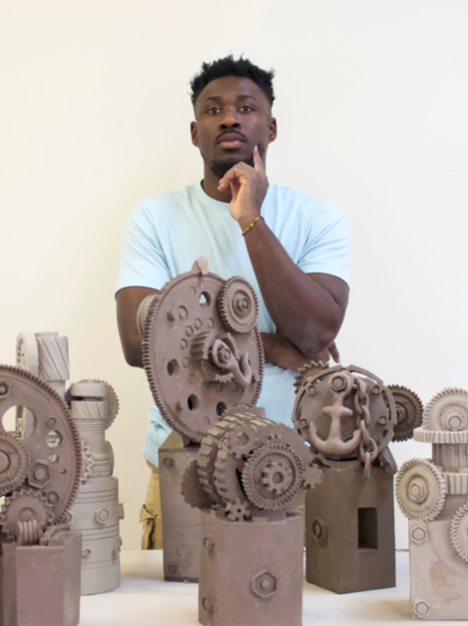
Vincent “Sniper” Frimpong is a contemporary ceramic artist and educator from Ghana, West Africa. His practice uses mixed media installations to create an open dialogue between the audience and the space the artworks inhabit, utilizing some elements of Ghanaian culture and the human hand as a tool to explore the idea of "What it means to be an African." Vincent holds an M.F.A. in ceramics from the University of Arkansas and a B.A. in industrial arts from Kwame Nkrumah University of Science and Technology (KNUST). His work has been in numerous solo and group exhibitions, while his research and creative practice have been supported by multiple fellowships and awards, including the 2025 NCECA Emerging Artist Fellowship, the Amaco Fellowship at Archie Bray Foundation, and the 2025 Rudy Autio Endowed Fund for Creatives, amongst other national and international institutions. Vincent currently serves as an assistant professor of art at Augustana College in Illinois.