
Weaving Cultural Connections Through Materials
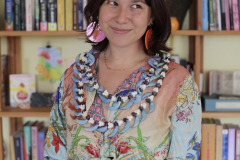
 Working with materials that have a rich history and physical process connects me to my heritage and helps me to create spaces that hold the past while imagining vibrant futures. I’ve always drawn with my materials, thinking with my hands in space. Clay has always been a body and material that has made me feel grounded and safe. A material that responds to how I think and move and forces me to be attentive and in constant engagement with its state and changes. As a multi-disciplinary, mixed-race, Malaysian-Chinese artist, my world has always been full of hyphens. Identity and materials categorized or broken into bits to explain something that is an expansive whole. I think it is natural, then, that I want to imagine new worlds and create work that speaks to the connections, strengths, and beauty of what it means to exist at an intersection. For me, this isn’t about proving that things can coexist, but unveiling the fact that they already do. So I draw on the specificity of my experiences, familial memories, and cultural heritage to provide space for them to breathe and grow. I root myself in materials and crafts that bring me closer to understanding where I come from, to find ways of understanding myself and my cultures, and to allow my work to grow.
Clay is the first material I fell in love with. Clay provides a home that I always come back to and think about whether it's in the studio with me or not. In the way I always come home to clay, the visual heart of my practice is Malaysian batik, weaving through all the work I make in every material. Batik is the process of lost-wax dyeing, where a wax resist is painted, stamped, or drawn onto fabric and dyed in layers and then removed to reveal the protected space. Slowly developing layers until a rich, colorful fabric full of designs is produced. There are two main batik processes I think about in relation to how I work in other materials: batik cap (stamped batik), where an intricate stamp is crafted normally from copper and then dipped in hot wax and stamped onto fabric; and batik tulis (hand drawn),  which uses a copper tool that is similar to a pen with a channel to hold hot wax that is used to draw on the surface of the fabric. In Malaysia, batik is deeply tied to cultural and national identity, with a vast diversity of processes and motifs that reflect the diversity of those who live there. Growing up, my aunties, uncles, and my great-grandmother would wear batik sarongs – pieces of batik cloth wrapped around the waist – both casually around the house and in full nyonya kebaya – traditional dress – for special occasions. Full of flowers, butterflies, and colors, my world has always been pattern on pattern. A vibrant and joyful expression of culture through cloth. It is what family feels like to me: the colors of batik; the sound of Hokkien – spoken by millions of the Chinese diaspora, with significant populations in Singapore, Malaysia, and Indonesia; rolling boiled eggs in leftover curry; and cutting oranges at the end of a meal connect me to a land I wouldn’t visit until adulthood.
I think a question a lot of us who grew up in the diaspora ask is, "What connects us to our homeland? What threads of continuity exist when we have never been to the place that we are of?"
For me, batik is the literal thread/process that weaves my cultural history into my work. Batik provides a way of drawing where, in the process, something is lost – wax – to make space for more.
Right before my first solo show at Sonoma Ceramics, my great-grandmother (Ahcha) passed away. This is when I first started working explicitly with batik motifs and fabric, as it suddenly felt urgent to honor her and my connection to my heritage in the wake of her passing. I started by using coils to make line work over plaster hump molds in mostly floral patterns, representing what would have been the wax resist for batik. Taking the line work and letting it become its own sculptural form in ceramics, later I would start rolling some of these coil drawings flat with a rolling pin for added dimension. These coil batik forms give the ghosts of material processes a home and life of their own. I do not see connecting to history or people who have passed away as something that strictly observes the past; instead, these connections are part of how we move forward. Who or what we carry guides how we move through the present and structures how we build a new future. In college, I was often asked to explain what it meant to be Malaysian/to be Chinese/to be mixed; my existence of hyphens was asked to speak for whole groups of people with a vast diversity of experiences. This is how I choose to explain, in the softness and specificity of the patterns of batik on my Ahcha’s sarongs, of unapologetic color and pattern.


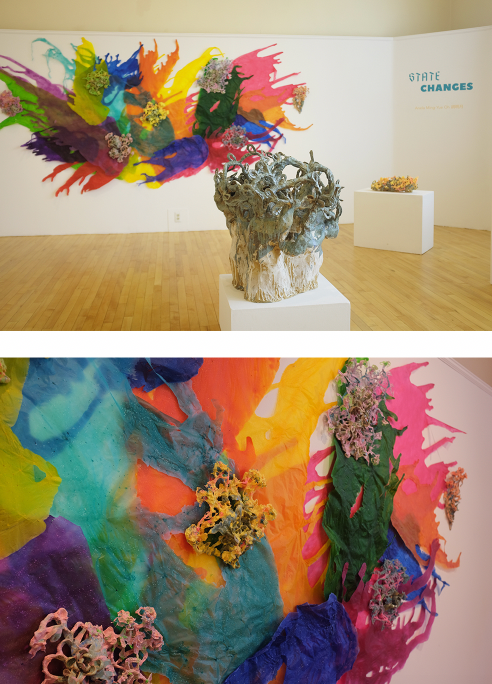
I then dragged these batik-inspired ceramic sculptures, in the State Changes series, through soft pulp, transforming them again with paper fibers. For these, I was using glaze as a resist, as the fibers only clung to the porous unglazed bisque. This process was a way for that line (literal coil or linework) that represents what is lost in the batik process to come alive. My materials themselves go through transformations, state changes. They reflect physical dualities – hard ceramic, soft fiber – in an effort to reform brokenness into something beautiful and new. In the kiln, clay solidifies, and quartz expands within its structure, sometimes cracking as it transforms. When paper dissolves into almost nothing in water, it is reformed through clinging to that which moves through it. I see cracks and fractures as sites full of potential for new growth, sites of change. My worlds are full of breaking and rebuilding. They are futures for me to look to, environments for me to learn from. The contrast between the hardness of the ceramic and the softness of the paper fibers emphasizes this meeting of cultures. Even materials so different are richer and more interesting together than apart.
 One of the major plants that shows up in batik is the hibiscus flower, bunga raya, which is Malaysia’s national flower. Bunga raya (Hibiscus rosa-sinensis) is part of the Malvaceae or mallow family, which includes plants such as cotton, okra, durian, cacao, and other hibiscus. Many of the plants in the mallow family have very similar flowers; as a result, okra and cotton especially resemble hibiscus inflorescences. My white maternal grandmother was raised in South Carolina as a sharecropper, working fields for other people, primarily picking crops like cotton and okra. And as an artist who lives and works in the kingdom of Hawaiʻi, with many endemic hibiscus plants, this plant family, its flowers, and its fruits have become integral to developing my own batik patterns to be used in my work. Connecting across oceans, my family, communities, and home. I started specifically using okra patterns in handmade paper works I made while a fellow at Dieu Donné Papermill. Creating stencils and using 3D pen technology to integrate these plants as parts of the batik visual language into my work. This has expanded the coil-building patterns and slip-trial imagery I use in the ceramic studio as well. Paper-clay slip trailing with deflocculated slip has been a beautiful way to connect to the wax processes of batik by drawing with clay in a new way that can be more specific to the imagery and plants that connect my cultures.
Clay provides a way to give form and life to drawn imagery, allowing it to become its own form while still tying it to its material history and transforming it further still through paper and fiber. I was never taught how to do batik and learnt from watching and talking to people in Malaysia on family trips and research there. There used to be a lot more Malaysian-produced batik, but lately it’s often demonstrated for tourism, and only a few communities still make it. Most batik used for clothing is sourced from Indonesia now, except for the handful of artists and craftspeople trying to keep the tradition alive and using it in contemporary manners and artwork. The desire to see this integral piece of my cultural heritage alive in the context of diaspora is extremely important to the way I integrate it into my own artistic practice, even in more abstracted ways. This is why referencing batik in clay with a relationship to fiber is at the heart of my practice, giving a new body and shape to my visual and cultural heritage. Culture is something alive and growing, and this meeting of many cultures is reflected in my materials and their processes.

Diaspora itself is a break in continuity between a homeland community and the family that has left, but there are larger historical breaks and scars that affect relationships to craft traditions, such as colonization. One such craft is barkcloth. As a craft-based artist, I spent a lot of my research time back in Malaysia trying to find traditions of papermaking and barkcloth in Malaysia – to very little success. Though we have proof that at one point barkcloth was made in my homeland, we look to our cousins in Indonesia and across the Pacific for any continuing practices. Meanwhile, here in Hawaiʻi, where I reside and have my studio, barkcloth is alive and well; it continues through artists, practitioners, and students of all backgrounds. I am so grateful that within my first weeks of moving to Hawaiʻi Island, I came to be at Roen Hufford’s studio with her amazing hui – group.
Roen is a recipient of a National Heritage Fellowship for the protection of kapa – traditional bark cloth made by Native Hawaiians – and is otherwise well known as an artist carrying on the tradition of Hawaiian kapa making while constantly transforming and pushing what it can be. This craft, which is present across other Pacific Islands, Southeast Asia, and parts of Africa, involves taking the bast of a tree, stripped as one whole sheet, and beating it out until it becomes a soft cloth. In Hawaiʻi, this art form was almost completely lost, and Roen’s mother, Marie McDonald, was part of the revival; notably, McDonald also received a National Heritage Fellowship for lei making. This is thanks in part to archived knowledge but mainly to Pacific Island brothers and sisters sharing what is still in living memory with a healthy dose of experimentation. Hawaiian barkcloth is called kapa, and though it was primarily used as cloth for clothes and ceremony, it is now being made as its own art form. Roen is what we call my kumu – teacher – and she has expressed the sentiment that “our ancestors made kapa because it was necessary, and today we make it also because it is a necessity.” Kapa making starts not with the prepared fibers but in the wauke or paper mulberry (Broussonetia papyrifera) patch. This plant comes genetically from the same plants that are used for papermaking across East Asia. It was brought as a canoe plant by Polynesians and spread across the Pacific. I love the image of what is brought in a canoe when you voyage to an unknown place; some plants were brought for no other purpose than as dyes. The patches at Kumu Roen’s farm were started by her mother. When the trees grow, you have to go out into the patch and pluck young branches constantly, as each branch will create a hole in the fibers of the kapa. So much time is spent just in a relationship with these plants and watching them grow before harvesting.
 When the trees are harvested, we strip the bast that day. The bast of a tree is the vascular layer just underneath what we know as bark, also known as the phloem. This layer of bast is the material used for barkcloth. There are many ways to scrape away or strip the outer bark off of the bast, but it is all done in the harvesting period, leaving you with a beautiful, long (whole if you are good at it) strip of bark-less bast. This is then rolled up and placed in salt water to ret – ferment – for several days. The retting process is something that doesn’t happen across all the different Pacific islands, but makes the bast softer and more pliable to beat.
When retted, the bast is beaten out on a rock – pohaku – with the use of a wooden tool – hohoa. This stage of beating out bast is called mo’o mo’o, the first beating. Something special to Hawaiian kapa is that the beating process isn’t considered complete at this stage – kapa is complete when you take multiple mo’o mo’o and layer them directly on top of each other and felt them together. This felting process is done on a wooden anvil – kua kuku or kua lāʻau – with a rectangular tool – i’e kuku – that has watermarks carved into the surface. These watermarks have different meanings as well as uses, but with kapa itself, the watermarks can be seen when lifted to the light, the same as papermaking watermarks. They will also be used texturally on the surface.
For me, the practice of kapa is not only a reclamation of an art form lost to my homeland, but also my grounding space and community center in the place where I reside. Through processing bast and beating kapa, we share about our lives, our struggles, our joys, and take care of each other. This practice is meant to be done in community, with many hands and a common goal, bringing us together. Many of us come from different backgrounds; whether that is using sculpture, glass, clay, and paper as our artistic practices or as cultural practitioners and teachers, we all come together over beating kapa. Even when each of us takes our kapa in a different direction, from sculpture to painted art to wearable objects to cultural practice, this diversity of uses of kapa is a direct reflection of Kumu Roen telling us to always “just try it” and push the boundaries of what can be made. Community learning is not limited to coming from the same material backgrounds; being present in process can always bring us together.
 Weaving these different practices together is what reflects the different worlds I come from and reside in, the people who have passed away, and the hope I have for our future. Always deeply steeped in community, culture, and materials. I cannot imagine my practice ever being one thing, for the softness of fiber makes the hardness of ceramic feel more intense, and the constant experimentation and transformation of these materials into harmonious partners is what it means to be multicultural. I cannot imagine my ceramic practice as not deeply tied to the material histories and practices of batik and kapa or vice versa. Part of working across mediums is that every exploration or process ends up informing how you work in the studio, not only conceptually but physically. From trying to replicate the movement of a batik wax pen in clay and give it three-dimensional life, to recently coiling my paper, as I do with clay, to integrate it with ceramic slip. It’s more work in many ways, but richer for it and full of exciting new moments every day.