
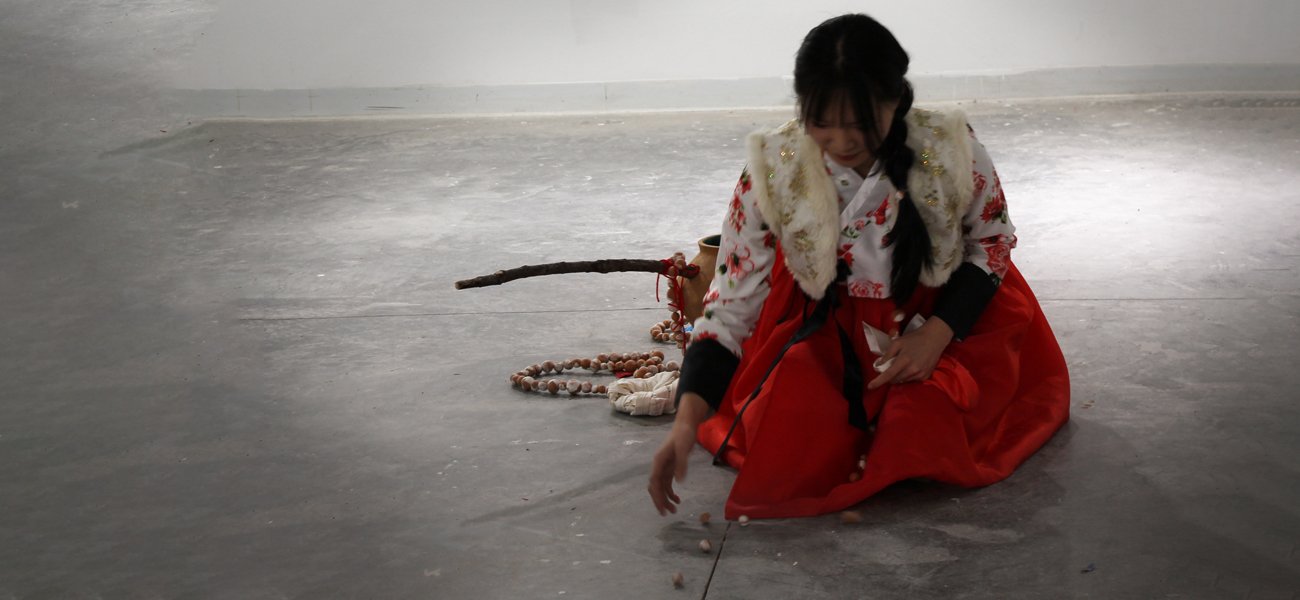
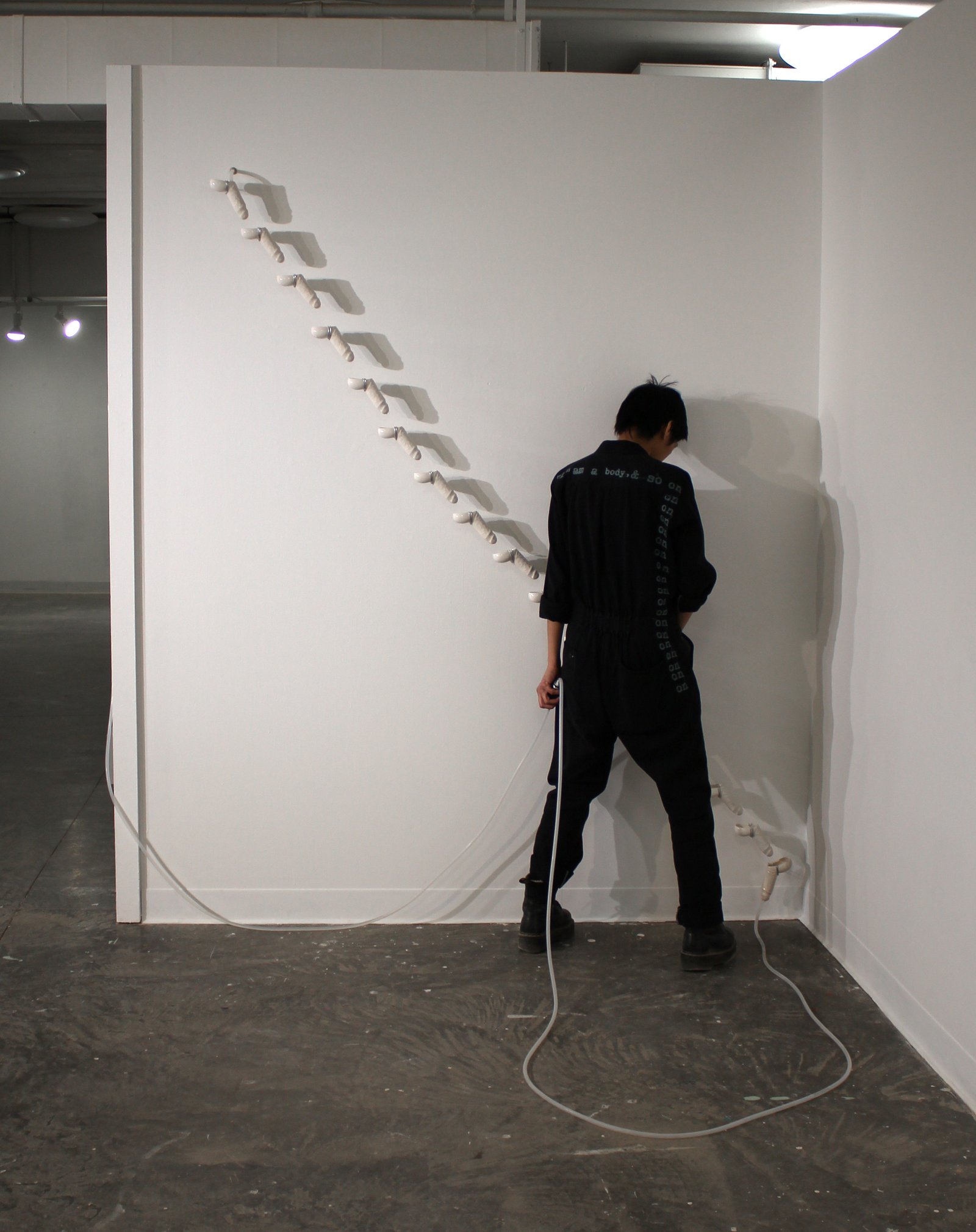
 Summer E. Aquino, their hips close up against a wall, urinates while friends and classmates huddle, pressed against the wall to the left in a tight line, and watch attentively. I sit cross-legged on the concrete floor behind Summer, taking notes in my sketchbook, leaning my back against the fourth wall of the space opposite the performance. I have been invited to observe the first critique of the semester in my colleague Eugene Ofori Agyei’s undergraduate course, Making and Thinking Through Materials at Alfred University in the basement of Harder Hall, and I am captivated.
Ceramics is almost, but not quite, the oldest artistic medium used by ancient humans, dating back 40 to 30,000 years. Only cave paintings are older, which, curiously, were made with the same pigments used in contemporary ceramics. The moving image is almost, but not quite, the newest medium at the baby-age of only about 140 years old, and, where the technology of ceramics is basically the same as the ancient era (dig, mix, form, fire), the technology of the moving image rapidly advances with each generation (film, video, 1040p, 4K). The oldest human-made ceramic form is a human female figurine, the Venus of Dolní Věstonice, found in what is now the Czech Republic. The oldest film known to exist, arguably, is called The Roundhay Garden Scene, filmed in Yorkshire, United Kingdom, in 1888 by Louis Le Prince, and features an almost three-second clip of male and female figures ambling about with large, obvious movements, creating motion to capture on film – in other words, performing for the camera.