Ghanaian Ceramics on the Rise
 Culture is overwhelmingly evident in all facets of Ghanaian life – in food, clothing, shelter, music, art, architecture, religion, and social interaction, and these constituents predominantly have their reflections on Ghanaian pottery – this is evident in pots’ form, color, and surface finish. For instance, fufu, a Ghanaian staple food that constitutes the pounding of cooked cassava and plantain, cassava and cocoyam, or cassava and yam, is a daily ritual in Ghana that connects the people to the art of pottery. To make fufu, plantains and/or cassava are pounded with a large (up to five or six feet) wooden pestle in a large mortar carved from the trunk of a tree. The art of making this delicacy is coupled with a rhythmic act of pounding, which converts into a musical sound that is familiar to every Ghanaian. In serving fufu, the admiration and value of apotoyowa, a local ceramic grinding bowl, for spices and vegetables, is overwhelming. Apotoyowa is also used for serving fufu, and comes with subtle textures within the inner space that allow grinding to be effective with a wooden pestle. Apotoyowa is used as a communal dish and provides a form of relational aesthetics within the interstice of busy schedules of present-day Ghanaian families. Pottery brings lots of connections to the lives and activities of the ordinary Ghanaian.
Ghana, like many other African countries, possesses a plethora of visual elements that bind culture, tradition, and relevance. Notable among these elements are Adinkra symbols and Kente, which were recently recognized and inscribed by the United Nations Educational, Scientific, and Cultural Organization (UNESCO) as Intangible Cultural Heritage. Revered Ghanaian ceramists and potters like C.N.K. Kokoroko, K.K. Broni, Kofi Asante, James Kwame Amoah, Joseph Kwame Nsiah, Parpah Senanu Kwawukume, James Bond Anane, Adu Darko, Frederick Ebenezar Okai, among others, skillfully incorporate these elements in their work to the admiration and fascination of many young contemporary artists. I was privileged to be taught and work with most of these different generations of artists who have had a major impact on my career as an artist and educator.
The recent achievements of the new generation of Ghanaian ceramic artists over the past five years have been profoundly consequential, particularly in reasserting the prominence of Ghanaian ceramics within contemporary art discourse. Their visibility and critical success have coincided with a notable rise in the enrollment of Ghanaian students in higher-education programs in the United States, as well as an increased recognition among public and private collectors of the cultural and artistic value of their work. Simultaneously, Ghana has emerged as a significant destination for study-abroad programs in ceramics, as educators in the field increasingly acknowledge the pedagogical importance of firsthand engagement with Ghana’s artistic and material cultures. Distinguished by their bold experimentation with form and materiality, these artists are advancing ceramics within expanded media practices and making compelling contributions to global contemporary art.
 The New Paradigm
The year 2018 saw a new paradigm of the young generation of Ghanaian ceramic artists entering the United States. What started as an opportunity and a privilege to earn MFA degrees culminated into filling six tenure-track teaching positions by Fall 2025 in various higher education institutions, namely, Lincoln University, Pennsylvania; Augustana College, Illinois; Talladega College, Alabama; Indiana University – South Bend, Indiana; Knox College, Illinois, and University of Texas Rio Grande Valley, Texas. They are entering the classrooms, studios, laboratories, and workshops with a student-centered philosophy to impact generations of makers – makers with critical thinking mindset;[1] makers with sense of self-worth and confidence;[2] makers who are inspired by their own narratives to make art;[3] makers who are conscious, empathetic, innovative, and harness the transformative potential of art to address complex issues of our interconnected world; [4] makers who understand the fundamental elements and technical processes involved in developing their artistic abilities;[5] and makers with a sense of openness, compassion and self-respect to embrace the uniqueness of their art.[6] Art has always been a powerful tool for change - challenging societal norms, questioning authority and amplifying the voices of the marginalized. Throughout art history, artists have used their work to shed light on injustices, inspire collective action, and imagine better futures. Whether through provocative imagery, subversive performance, or compelling narrative, art’s ability to influence society lies in its capacity to invoke emotions, spark dialogue, and unite people around shared ideals.[7] Aside from their personal experiences, the invaluable impact that art carries is one of the inspirations that propel these artists to teach and educate.
These artists have exhibited widely in museums and galleries across Europe, Asia, and more than thirty states in the United States, and have contributed to scholarly and professional discourse through lectures, presentations, and artist talks at platforms such as the National Council on Education for the Ceramic Arts (NCECA) and the African Studies Association (ASA). Their practices have also received sustained institutional recognition through a range of awards and fellowships supporting artistic production, research, and pedagogy. These include national and regional grants from organizations such as the Walton Family Foundation, Mid-America Arts Alliance, and the Windgate Foundation, as well as university- and museum-based honors recognizing excellence in creative practice and academic engagement. Collectively, this recognition reflects a growing institutional investment in Ghanaian ceramic practice as a critical and contemporary field rather than a marginal or traditional category.
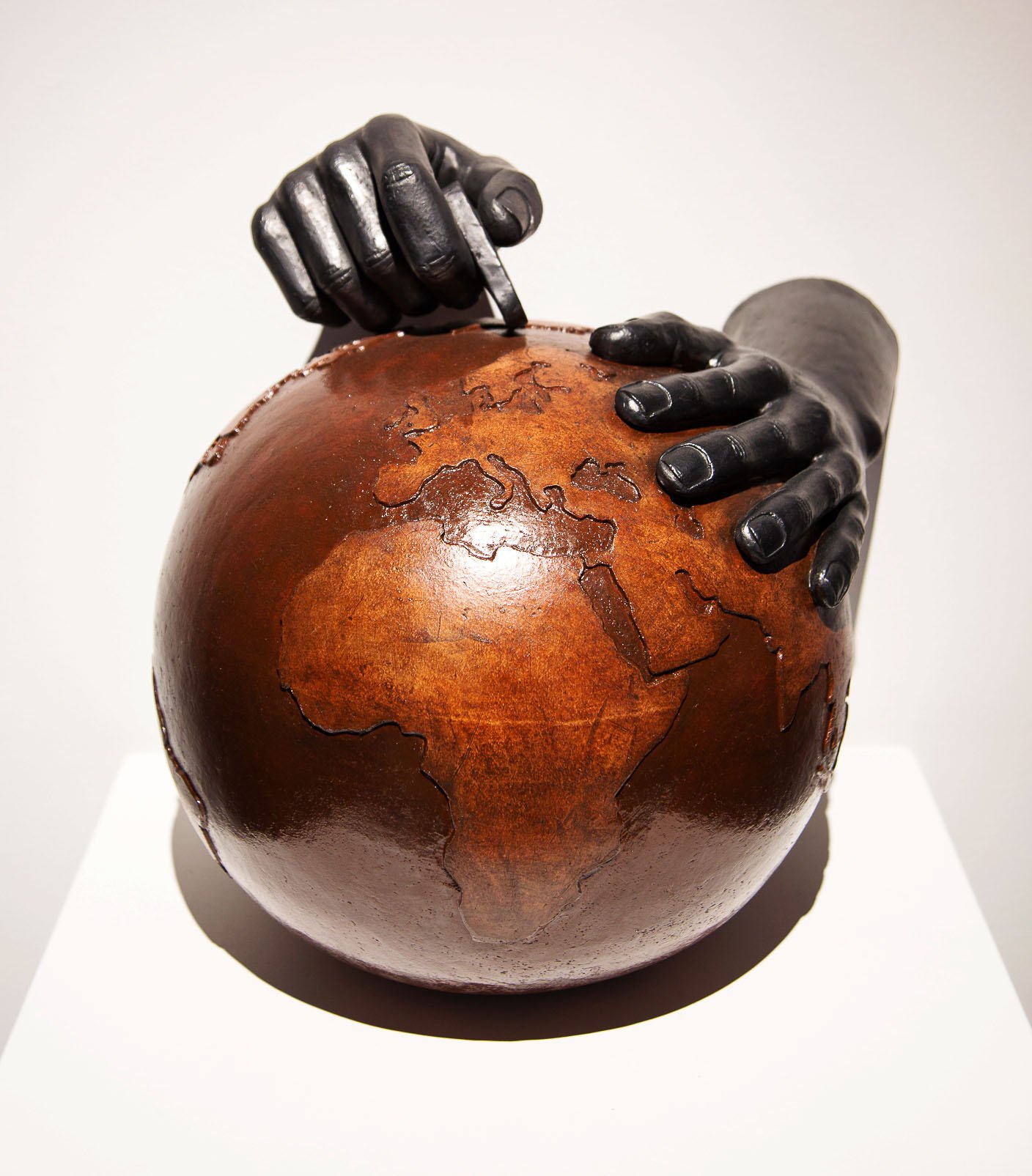
Paying Attention to the Horn of Their Hometown
Through their practice, these ceramic artists state:
“As a multimedia artist, I am interested in involving the audience through interactive space by using video, sound, projection, drawing, and sculpture pieces to create a setting that allows for an open dialogue between the works and the audience.” – Eric Andre, artist statement
“… my work functions as a site of negotiation where fragments of experience are assembled into new configurations of self. Through material transformation and form, I invite viewers to consider how identity is continually constructed through movement, place, and cultural exchange. – Ross Owusu Junior, Artist Statement
“I use mixed media installation to create a space that allows for open dialogue between the audience and the space, utilizing some elements of Ghanaian culture and the human hand as a tool to explore the idea of what it means to be an African. I want my work to draw audiences to experience the richness of some aspects of African culture and their relevance to our contemporary world. I desire to make sculptural installations that communicate ideas to make viewers recognize that what people think they know is not always the whole truth.” – Vincent Frimpong, artist statement
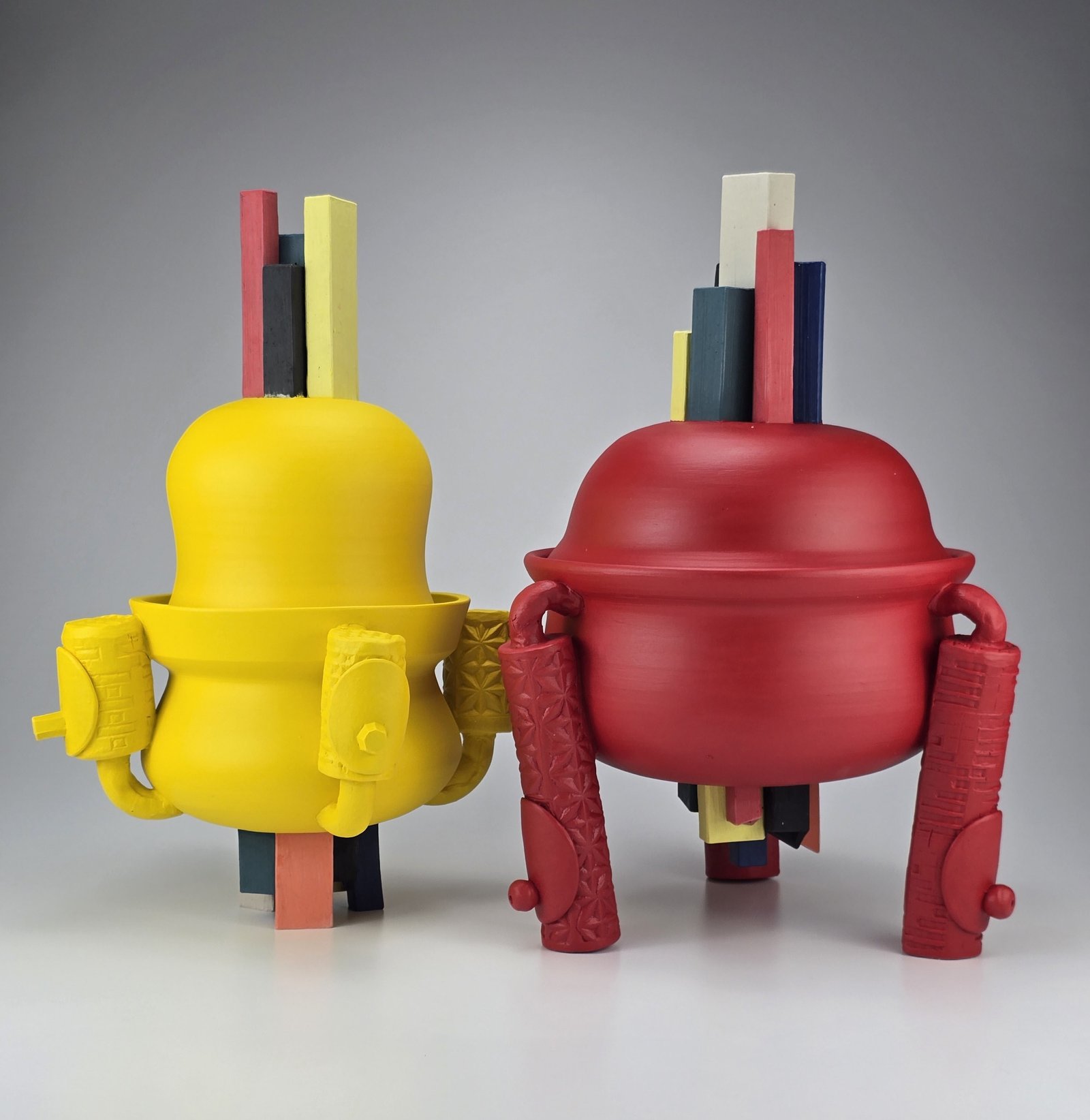
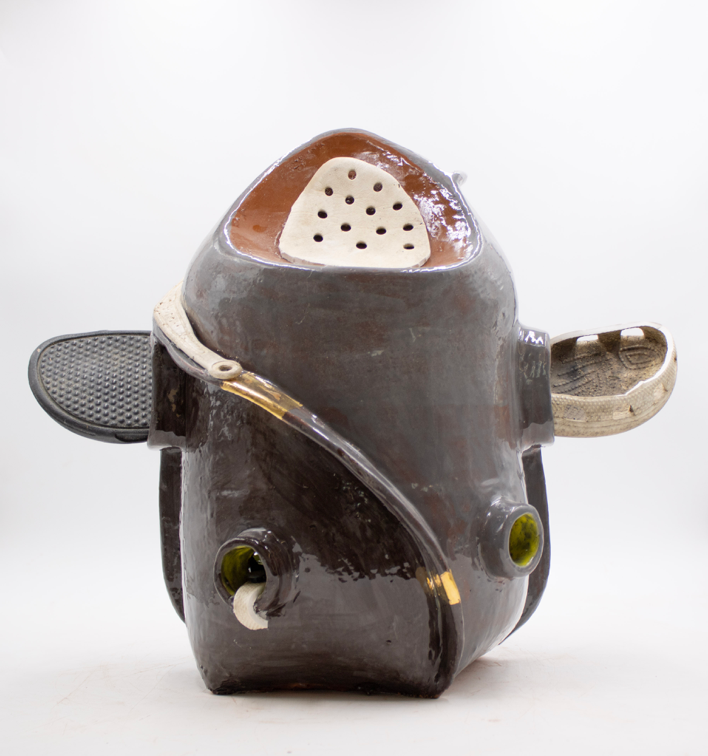 “Each vessel carries a dual pulse, as it’s rooted in my own story, yet open to viewers in the hope that people recognize something of their own journey, whether in the pull of memory, the uncertainty of transition, or migration. In the end, my work embraces the tangibility of life, where cultures meet, identities shift, and nothing is ever entirely fixed.” – Teddy Osei, artist statement
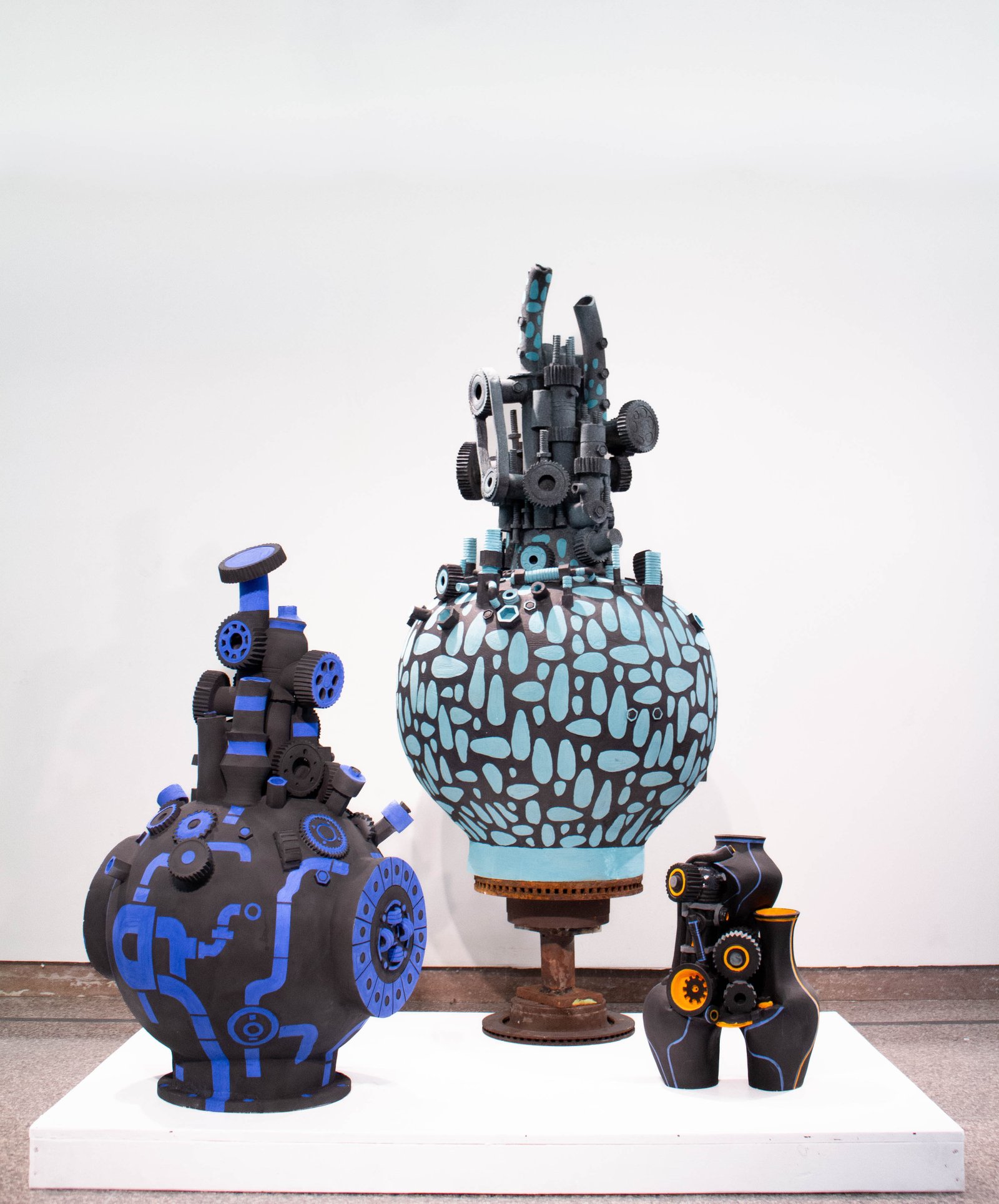
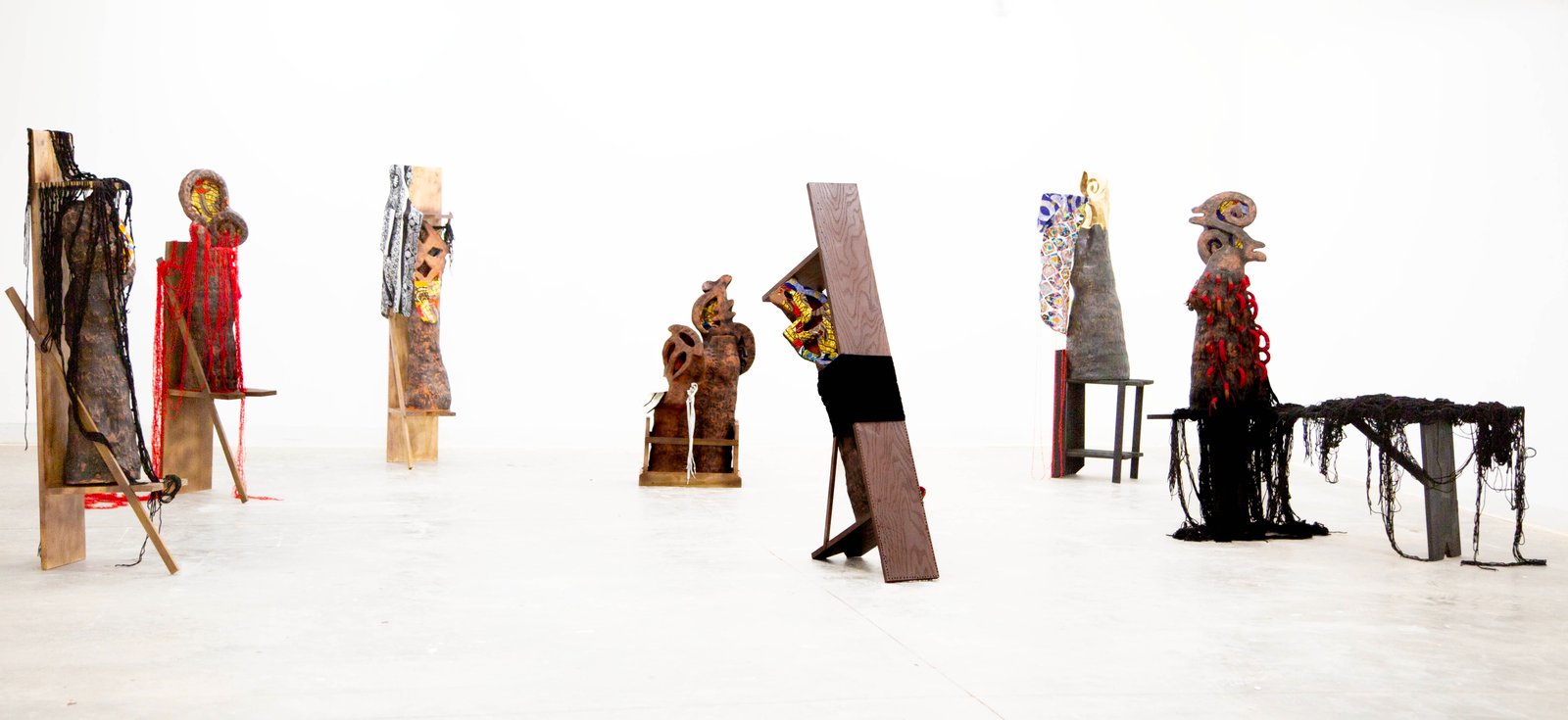
“Through sculptural assemblage, I employ multicultural materials to explore the condition of strangeness within unfamiliar spaces. The work becomes a visual metaphor for my diasporic journey, and its impacts on identity, addressing the layered complexities of crossing borders. Grounded in personal and collective histories, I create a space of reflection, inviting viewers to consider how identity is shaped by place, movement, and displacement.” – Eugene Ofori Agyei, research statement
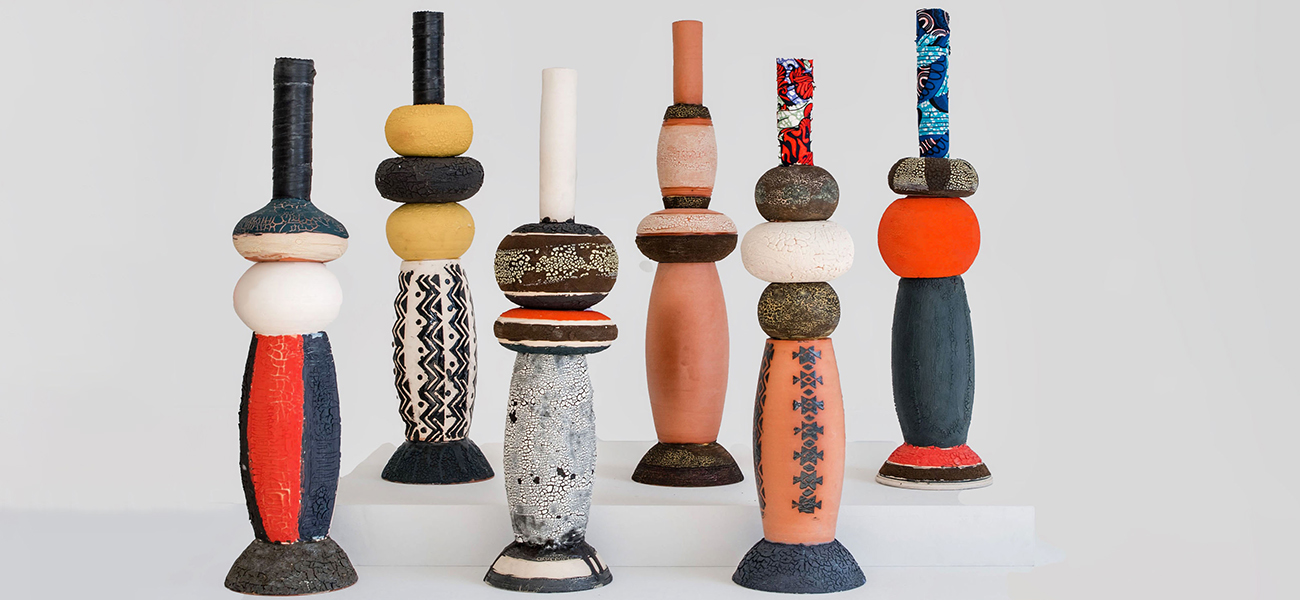
“My work engages with the profound legacy of Ghanaian ceramics, bridging its rich historical foundations with a bold contemporary vision. Drawing upon the intricate symbolism of Kente patterns in textiles and Adinkra motifs, I transform these culturally significant elements into a visual language that challenges traditional boundaries and redefines ceramic art on an international stage. By navigating the intersections of form, symbolism, and materiality, my practice interrogates the tensions between tradition and modernity, cultural preservation and innovation, as well as the dynamic exchanges that occur within and across cultures.” – Japheth Asiedu-Kwarteng, research statement
It is evident that the practice of these artists reflects the culture and traditions of Ghana and Africa. They are reshaping Ghanaian ceramic art narrative, retelling the Ghanaian story from a more nuanced perspective that is quite deeper than personal, which is yielding immense results and bringing about change. This is no coincidence; it is intentional. Maya Angelou said, “If you don’t like something, change it. If you can’t change it, change your attitude.”[8] These artists are rewriting the script for the Ghanaian story, clearly honoring the Akan proverb, Sɛ wowerɛ firi wokrom abɛn a, woyera wɔ badwam – to wit, if you forget the sound of the horn of your hometown, you get lost at a gathering.
The Road to Independence
These achievements did not come on a silver platter; they did not come without sacrifices. There were/are a lot that had/have to be unlearned and learned as one leaves their homeland to occupy a foreign land – there is a lot to leave behind. It is mostly riotous to take a new route while tracing your roots. This has been the struggle while striving to rewrite the narrative.
It is safe to categorize their art as diasporic because they are making art in a foreign land – the diaspora, with inspiration and representation from their roots.
As Sieglinde Lemke suggests, diaspora is defined not only by a complex interplay of roots, routes, and moments of rupture that emerges through cultural and political encounters.
Although these artists are not exiles in the traditional sense, their relocation has entailed significant forms of loss-distance from place, community, and familiar modes of making. Rather than allowing these losses to undermine their practice, they are redirected into material and conceptual inquiry. Their work reflects an ongoing process of reconstruction, where memory, cultural reference, and contemporary experience are assembled into new visual languages that respond to both personal histories and collective conditions.
Within this framework, their ceramics function as sites of negotiation rather than nostalgia. Identity is articulated as fluid and continually reshaped through movement and exchange, positioning Ghanaian ceramics as a dynamic contemporary practice grounded in cultural specificity while responsive to global circulation.
These artists, whom I refer to as the “Big Six,” are Vincent ‘Sniper’ Frimpong, Ross Owusu Junior, Teddy Osei, Eugene Ofori Agyei, Eric Andre, and Japheth Asiedu-Kwarteng. To call them the Big Six is not out of place since their practice to rewrite the narrative of Ghanaian ceramics and the Ghanaian story in the diaspora is similar to the exploits of the big six - Kwame Nkrumah, J.B. Danquah, Ebenezer Ako-Adjei, Edward Akufo-Addo, Emmanuel Obetsebi-Lamptey, and William Ofori Atta – who gained independence for Ghana on March 6, 1957.
As their works enters public and private collections nationally and internationally – including Mississippi Museum of Art, Jackson, Mississippi; University Galleries, Normal, Illinois; Franz, Duke of Bavaria, Contemporary Art Collection, Munich, Germany; Changchun International Ceramic Museum, Changchun, China – it points toward a future in which Ghanaian ceramics is recognized not as peripheral, but as an active and evolving contributor to global contemporary art.
NOTES:
1. Eugene Ofori Agyei, Teaching Philosophy.
2. Eric Andre, Teaching Philosophy.
3. Ross Owusu Junior, Teaching Philosophy.
4. Vincent Frimpong, Teaching Philosophy.
5. Teddy Osei, Teaching Philosophy.
6. Japheth Asiedu-Kwarteng, Teaching Philosophy.
7. Ahmed Musah, The Psychology of Art: Understanding Why We Create, audiobook, chap. 10.
8. Maya Angelou, “50 Quotes About Change,” Margaretha Montagu, accessed February 13, 2026, https://margarethamontagu.com/50-quotes-about-change/