Shopping cart 0 items
Donate
Member Login

Search form

Share
Login
Home
  • About
    • Mission
    • History
    • Masthead
    • Board of Directors
    • Contact
    • Privacy Notice
    • FAQ
    • Internships
  • Articles
    • Current Articles
    • Collections
      • Interviews
      • Narrative
      • History
      • Technology
      • Criticism
      • Other
    • Print Archive
    • Write for SP
  • Announcements
    • General
    • Classified
    • Events
    • Newsletter
  • Become a Member
  • Grants for Apprenticeships
  • Donate
    • Underwriting
    • Donate
    • Partners
  • Store
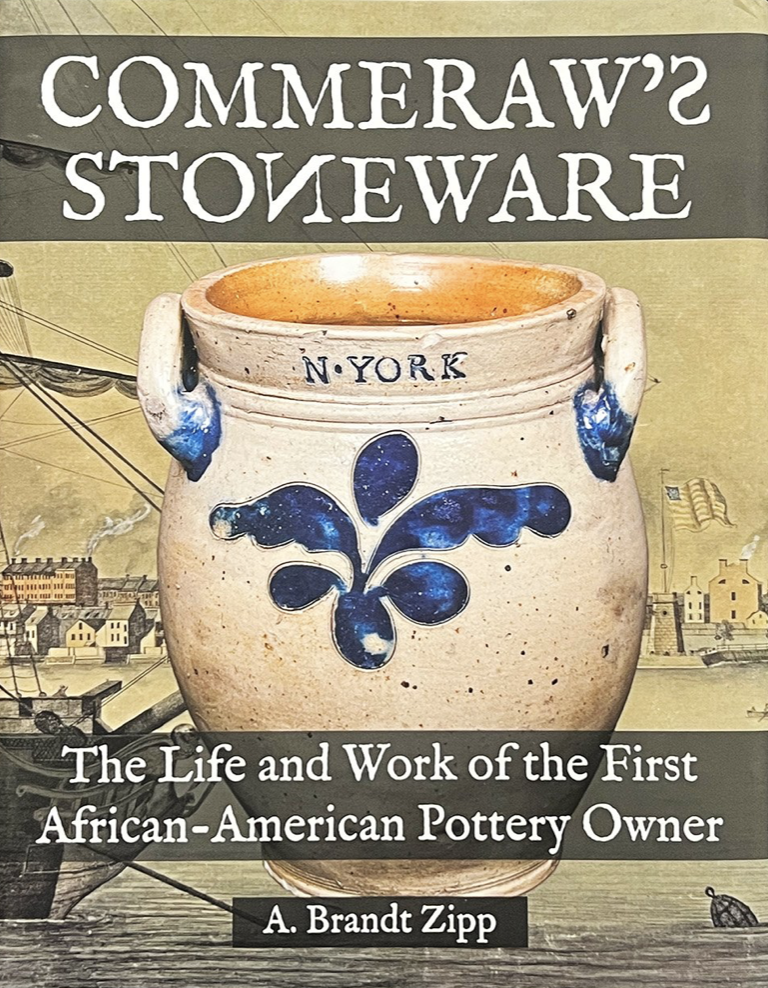
Pages from Commeraw’s Stoneware – The Life and Work of the First African-American Pottery Owner, By Brandt Zipp.

Book Review: Commeraw’s Stoneware – The Life and Work of the First African-American Pottery Owner

Jack Troy

Commeraw’s Stoneware – The Life and Work of the First African-American Pottery Owner

By Brandt Zipp, www.commeraw.com

311 Pages. Profusely illustrated.


Those of us interested in early American salt-glazed stoneware are a curious lot, and this meticulously researched book solicits the question: "How curious are you about a free Black potter and business owner who made crocks, jugs, and other pottery in Manhattan’s Lower East Side in the late 1700s and early 1800s?"

Thomas W. Commeraw, born 1771 or 1772, first appeared in the Corlears Hook area in 1794, having been born into slavery and owned by one of America’s first stoneware potters, William Crolius. When Crolius died at age forty-seven in 1779, the terms of his will freed the young Commeraw, then eight years old, who would become a renowned potter and establish a manufactory, reputation, and political consciousness of his own.

Growing up in a sleazy area of the city rife with brothels and saloons (the term "hooker" probably originated in Commeraw’s part of town), he would have served an apprenticeship of hard labor before learning to throw. "Ball boys" wedged and weighed clay for turners," working at wheels powered by spinning a flywheel with a stick, then sitting above it and fashioning a form through cycles of diminishing momentum. Learning to read and write while developing a faith life he never abandoned, all the while working in the company of skilled German potters, gave the young man a disciplined work ethic worthy of respect when he completed his apprenticeship, married, and started a family.

...
Read more

More from this issue

August 2023

Brittany Mojo, The Swell (nowness again), installation at Mindy Solomon Gallery, 2023. Photo courtesy of Mindy Solomon gallery.
Accumulative Time
By Brittany Mojo
And then the unthinkable happened.

My father passed away suddenly during my second semester, which drastically impacted the way I thought about my work – what I was making and why I was making it. Coming from a thinking-through-making experience at CSULB, it seemed the exact opposite was true at UCLA. Everyone was reading Derrida, Solnit, and Lacan – gathering ideas and metaphors as the first step to realizing a piece. I, however, was in mourning, and I needed to rely on my practice to offer respite and on literature to offer answers to questions that have plagued humanity since the beginning of consciousness. Mourning became my life’s work. It was tragically difficult and incredibly lonely.
Read More
Sponsored Content
Sponsored Content
By Adamah Art Studios
It was during Steven’s Throwing Gestural Forms workshop that Katie, an entrepreneur and busy mother of two, learned about The Journey Workshop. "It’s a big investment, not just financially but also in time," she shared. "I knew from my previous experience of being in Steven’s classes what a wonderful teacher he is, but I wasn’t sure I would be able to follow through with this time commitment. I reached out to some people who I knew had previously participated in The Journey to learn more. Many of them were already signed up to do it again, which spoke volumes about the kind of growth they found from the experience."
Read More
Nick Vest buying two objects at the Ghost Market  to start work with. Photo by Wu Fan
Gathering What’s Needed: 400,000 Potential Collaborators
By Nick Vest
I didn’t mean to come here; I "knew" about Jingdezhen, of course, about blue and white pots and porcelain, but I’ve never been a person in love with clay in THAT way. I fall into the "clay is a material" camp of ceramic artists and thought that Jingdezhen was a place for people more in the "clay is life from the earth" wing. I was wrong, and coming here was the best thing I’ve ever meant not to do.
Read More
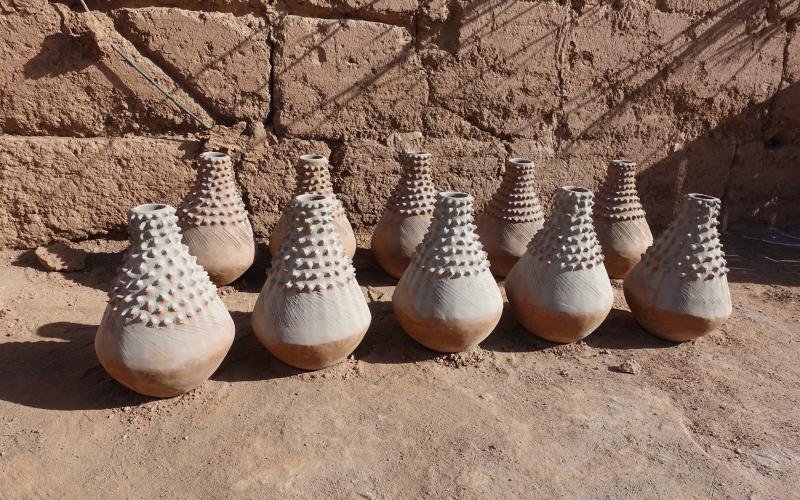
Astour, near Zagora, Oasis region. These unique pieces, nearly 30” high, were commissioned by someone in a big city as decorative pieces in a hotel or mall. The white coating is ash from the fire pit.
Rural Red Clay – An Artist’s Journey Through the South of Morocco
By David Packer
"The weekly souk is a central part of rural life in Morocco. On an appointed day, established centuries ago, vendors congregate in a space, often on the edge of town, to sell their products. In a country that only has malls in the large cities, souks are the centers of commerce for everything locals need: livestock, food, housewares, clothing, bric-a-brac, carpets, and, of course, pottery." This month's FREE article.
Read More
Simone Leigh, Trophallaxis, 2008-2017. Collection Pérez Art Museum Miami. Copyright: © Simone Leigh. Photo: Farzad Owrang.
The Dynamics of Transfer
By Chenoa Baker
Trophallaxis focuses on the breast as a site of labor. In that, there is the juxtaposition of comfort and discomfort, familiar and unfamiliar: the cracking nipples and boot prints showcase bodily violence and the physical impact of breastfeeding. Fecund breasts with gold-plated areoles and nipples, constructed from terracotta, porcelain, antennae, and epoxy, suspending from the ceiling.
Read More
Back to Issue

Author Bio

Jack Troy

Jack Troy is a potter, writer, and educator. Troy taught at Juniata College for thirty-nine years and has led hundreds of workshops across the country and around the world. He has published two books, Wood Fired Stoneware and Porcelain, Salt Glazed Ceramics, and two books that are a collection of poems, Calling the Planet Home and Giving It Up To the Wind.  Jack has written many essays and articles for major publications in the field, including Inscapes, a privately printed tribute to David Shaner. He has been recognized by the National Council on Education for the Ceramic Arts and the Pennsylvania Council on the Arts. 


jacktroy.net

CONTACT  |  NEWSLETTER SIGNUP  |  COPYRIGHT © 2026 STUDIO POTTER  |  SITE DESIGN

Design by Adaptive Theme

Member Log in

  • Create new account
  • Reset your password
Forgot your password?
Continue as Guest
Become a Member
Library IP Login