

Contemporary Californian Kizaemon
A couple of years ago, I was invited to judge the 2025 Strictly Functional Pottery National competition and exhibition held annually in Lancaster, Pennsylvania. I was honored to say yes. My first task was to choose between 892 images of pots that had no names attached, submitted online by 354 ceramic artists. The clear yes and no responses were easy; the maybes required more time. I knew who’d made some of the pots, but most I didn’t, and eventually I made my final selections, winnowing the entries down to 159 pieces from 153 potters.
During my scrolling, several pots caught my eye, and I wondered how they’d look in the flesh, but I had to bide my time before travelling to Lancaster to see them all and pass final judgement. When I arrived, I decided to continue my “blind” approach, choosing not to look at the labels nor look up makers on the web, and make my selections for a variety of categories – Best of Show, Best Use of Color, Best Thrown and Altered, etc., based only on my lifetime of making and looking at pots.
Three slip-cast porcelain wood-fired pilsner tumblers had haunted me from the moment I saw them. They were simple, straight-lined shapes with dynamic surfaces from their long firings. They blended the industrial practice of slip-casting with the artisanal practice of anagama firings. This combination caused echoes to reverberate.
One concerned Polish porcelain artist, Marek Cecula’s series, “In Dust Real,” where he’d taken ornate molds of teapots, cups, and saucers and trays from old inactive European porcelain factories, slip-cast them, and then subjected the resulting pots to lengthy wood firings. The results were simultaneously beautiful and jarring, two types of ceramic excellence unexpectedly fused.
The other resounding echo concerned the Kizaemon O-Ido tea bowl, a 16th-century Korean rice bowl appropriated by Japanese aesthetes to become a ritual object used in the Tea Ceremony, prized for its rustic beauty, imperfections, and significance in Zen Buddhist aesthetics, which became a Japanese National Treasure and one of the most celebrated pots in the functional ceramic canon.
Returning home from Lancaster, I got busy catching up with all the work I’d left undone and delayed calling the potter who made the pilsner tumblers. The very morning I planned to call the maker to celebrate my choice I received an Instagram message from a friend and fellow wood-firing potter, saying, “I found your choice perplexing, the tumblers lovely, but not exciting,” which prompted me to reach for my dogeared copy of Soetsu Yanagi’s book, “The Unknown Craftsman,” and read the famous passage he wrote about the Kizaemon O-Ido tea bowl.
“For a long time, I wished to see this Kizaemon bowl. I had expected to see that 'essence of Tea,' the seeing eye of Tea masters, and to test my own perception; for it is the embodiment in miniature of beauty, of the love of beauty, of the philosophy of beauty, and of the relationship of beauty and life. It was within box after box, five deep, buried in wool and wrapped in purple silk.
“When I saw it, my heart fell. A good Tea-bowl, yes, but how ordinary! So simple, no more ordinary thing could be imagined. There is not a trace or ornament, not a trace of calculation. It is just a Korean food bowl, a bowl. Moreover, that a poor man would use every day – commonest crockery.
“A typical thing for his use; costing next to nothing; made by a poor man; an article without the flavour of personality; used carelessly by its owner; bought without pride; something anyone could have bought anywhere and everywhere. That’s the nature of this bowl. The clay had been dug from the hill at the back of the house; the glaze was made with the ash from the hearth; the potter’s wheel had been irregular. The shape revealed no particular thought: it was one of many. The work had been fast; the turning was rough, done with dirty hands; the throwing slipshod; the glaze had run over the foot. The throwing room had been dark. The thrower could not read. The kiln was a wretched affair, the firing careless. Sand had stuck to the pot, but nobody minded; no one invested the thing with any dreams. It is enough to make one give up working as a potter.
“In Korea, such work was left to the lowest. What they made was broken in the kitchens, almost an expendable item. The people who did this were clumsy yokels; the rice they ate was not white, their dishes were not washed. If you travel, you can find those conditions anywhere in the countryside. This, and no more, was the truth about this, the most celebrated tea-bowl in the land.
“But that is how it should be. The plain and unagitated, the uncalculated, the harmless, the straightforward, the natural, the innocent, the humble, the modest: where does beauty lie if not in these qualities? The meek, the austere, the un-ornate – they are the natural characteristics that gain man’s affection and respect.
“More than anything else, this pot is healthy. Made for a purpose, made to do work. Sold to be used in everyday life. If it were fragile, it would not serve its purpose. By its very nature, it must be robust. Its healthiness is implicit in its function. Only a commonplace practicality can guarantee health in something made.”
On my subsequent call to Jacque Adams the maker of the series of slip-cast pilsner tumblers, it turned out that she did not know about the Kizaemon O-Ido tea bowl, nor Yanagi’s essay, so I began to ponder whether it would be possible in this day and age to make something that possessed the qualities Yanagi describes, and if so, how much did Jacque Adams work resemble this ideal?
Jacque is by no means a complete unknown, but she is not a potter who is well known. This is her story. Raised in Columbus, Ohio, her father managed a pizza shop, and throughout her childhood, she worked folding boxes and drinking soda at the back of the restaurant. She received her BFA from Ohio State, where she first learned mold making, and got her MFA at the University of Florida. A residency at a porcelain manufacturing company in Arita, Japan, gave her further expertise in mold making, although her work is now predominantly wheel-thrown. She lives in Northern California near Hidden Valley Lake with her three-year-old daughter, Lila, and has a studio in her garage. Twice a year, she helps fire an anagama kiln at the nearby Cobb Mountain Art and Ecology Project, where her pilsner cups were fired. The lengthy wood firing gave her cups their distinctive surfaces. She teaches two classes a semester at Mendocino College, in Ukiah, California, and works as a ceramic technician at the college’s branch campus in Lakeport, California.
The lives and practices of contemporary potters are many and varied, and I know several potters with similar stories to Jacque’s. Well-trained, with student loans, renting spaces in which to live and work, with part-time teaching gigs at colleges and community centers, firing in other people’s kilns, piecing it all together in a fickle economy.
Like the Kizaemon O-Ido tea bowl, her pilsner tumblers are unsigned, an anomaly these days, echoing pots made by legions of mythic, “unknown craftspeople,” but it turns out the lack of signature resulted from the rapid drying of the slip cast tumblers, which prevented her from incising her normal signature. So, it was an accidental omission, not deliberate.
Jacque told me that the inspiration for her tumblers was the red Coca-Cola cup she used to sip her soda from as a child at the back of her father’s pizza shop. She had made a mold of the plastic cup, complete with cap, which accounts for the slight flare at the rim of the silhouette. The Coca-Cola cup and her porcelain pilsner interpretation are manifestly practical, designed to be held comfortably in the hand. Its sleek lines have a modernist simplicity.
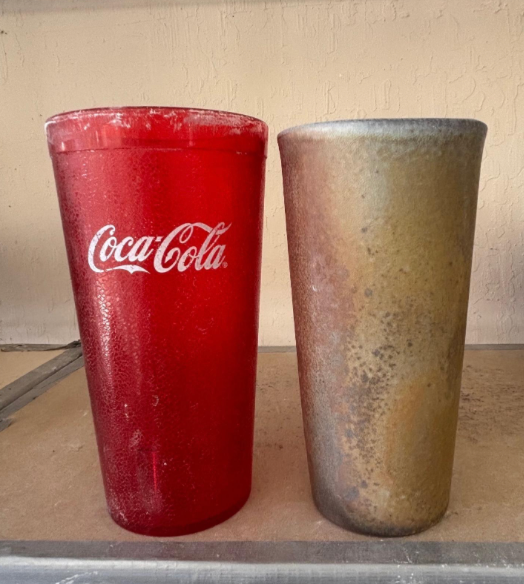
Does this mean that a plastic soda cup is the contemporary equivalent of the Kizaemon O-Ido tea bowl? Or that Jacque’s slip-cast tumbler is just a trite reimagining of a ubiquitous disposable contemporary object?
Her pilsner tumblers hold a palpable tension. Combining slip-casting and anagama firing is intriguing, slip-casting functional pots being more often associated with industrial practice, and lengthy wood firing with the artisanal. In this case, the fusion feels fluid – complementary, not contradictory – and deserves further fruitful exploration. Perhaps I was drawn to these cups because these seemingly oppositional practices reflect my own life. Born and raised near Stoke-on-Trent, England, into an industrial pottery family, but I apprenticed with Michael Cardew and fired wood-burning kilns my entire career until recently. Jacque’s pots reflect this dichotomy.
The surfaces of her three tumblers in the show were quite different. One had the full fiery flash produced when porcelain is fired for several days in a cross-draught wood-fired kiln, creating unendingly varied tapestries. Brilliant vortices of sunset pink and orange harmonize with cool satin sheets of white, while fly ash drips ooze juicily down its flanks. A veil of crystals from slow cooling dapples the surface. I could have easily chosen this one as the winner.
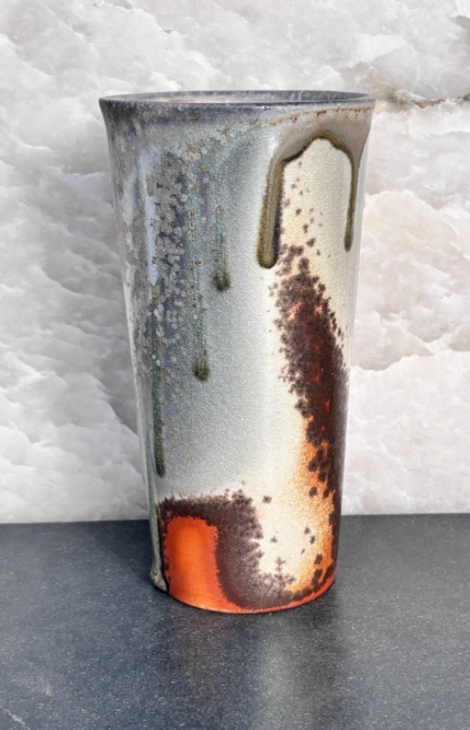
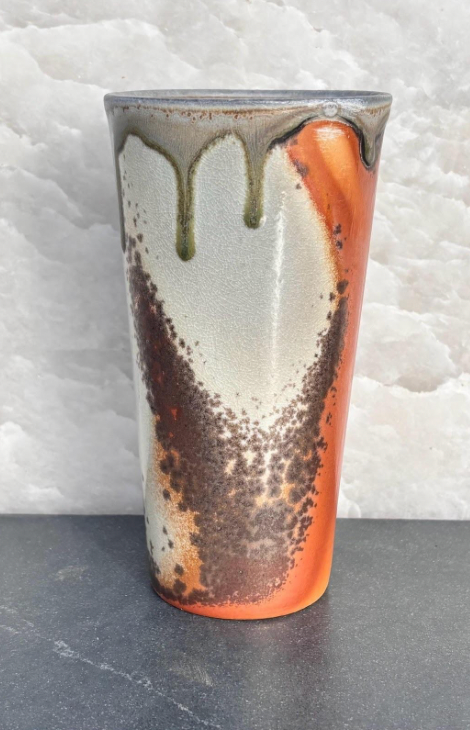
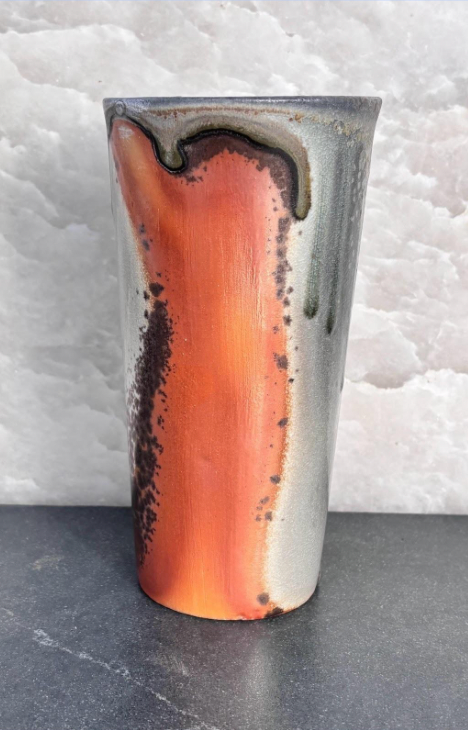
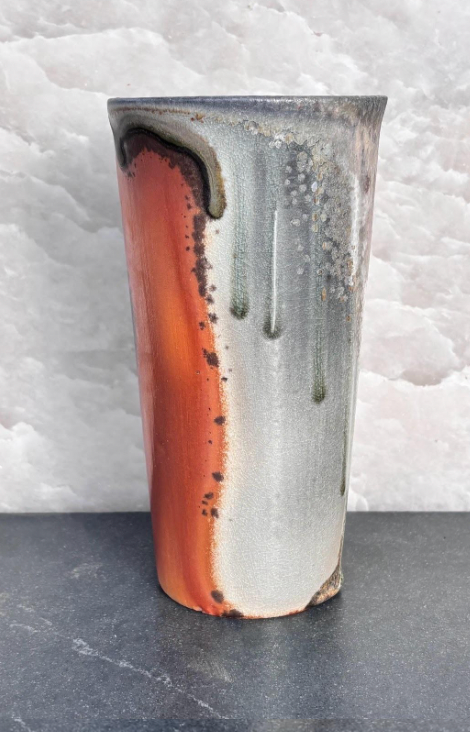
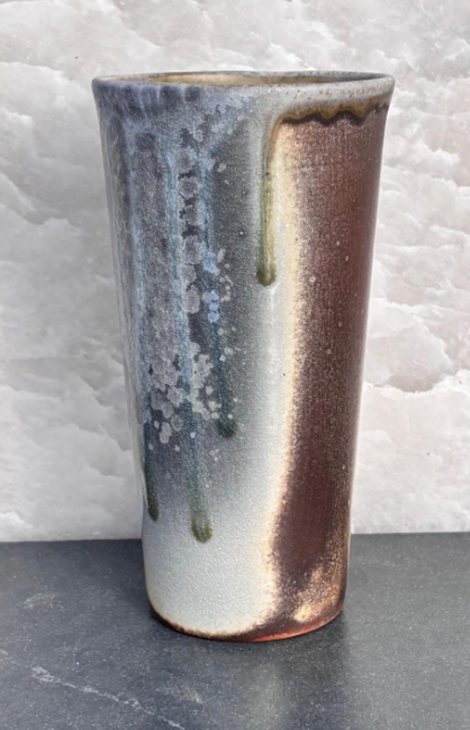
The second was calmer and more nuanced, with tonal variations suggesting the quiet before sunup. Alas, having bought two of the three tumblers, I now kick myself for not having bought this one so I could describe its delightful details.
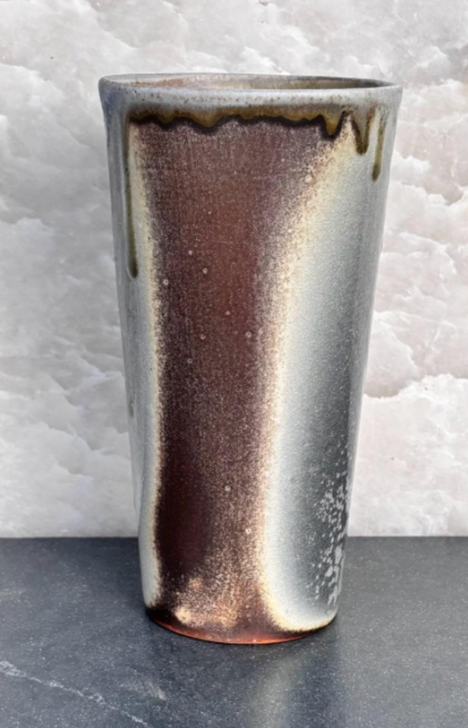
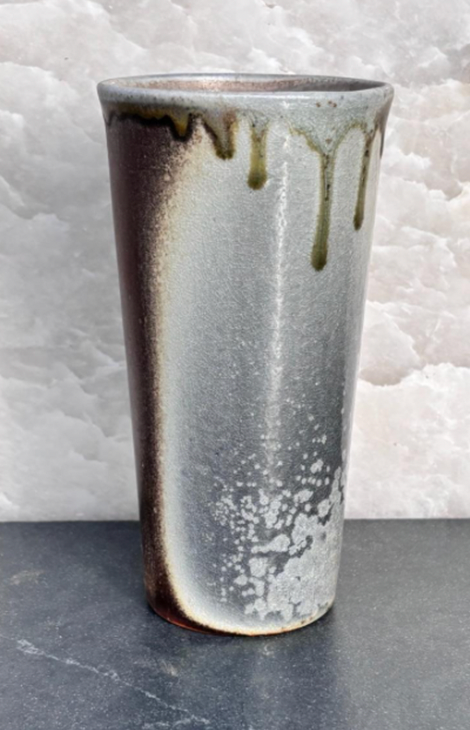
The third, which I chose as the winner, has a moodier atmosphere, with slick gray foggy patches encrusted with jewellike crystals yielding to a shadow of forest brown. A cascade of blue ash drips created a liquid, almost snowy, landscape – a strange outcome given the sustained 2350 Fahrenheit firing temperatures. As I turned the tumbler, I went on a wintry morning drive down a dark valley surrounded by sequoias.
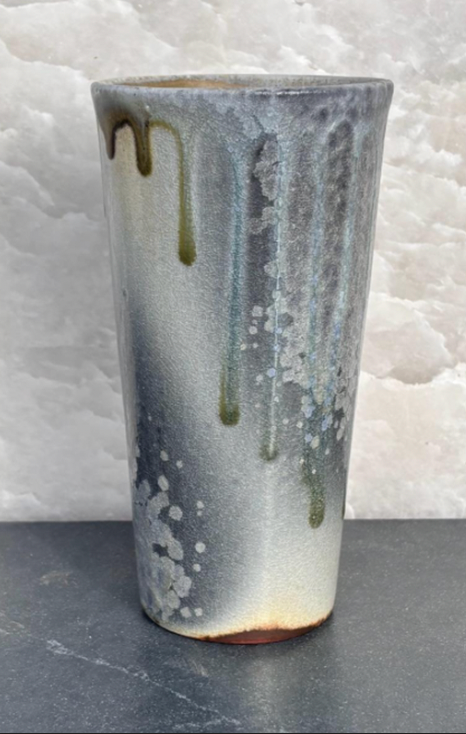
I imagine other tumblers in the hands of unknown drinkers in redwood brew pubs, happily unaware of Jacque, “The Unknown Craftsman,” or anagama firings, momentarily transported by alcohol and tumbler into poetic reverie.
Seeing Jacque’s pilsner tumblers was like seeing three butterflies fluttering by with unbidden beauty. In a small corner of Northern California, an almost accidental beauty seems to have been born and not made.
Well done, Jacque! Thank you, and please make more.