Clay Embodies Refuge
Ty Murray
What was the moment when clay stopped being a workshop activity and became something you knew would stay with you?
Jazzmine Curtis
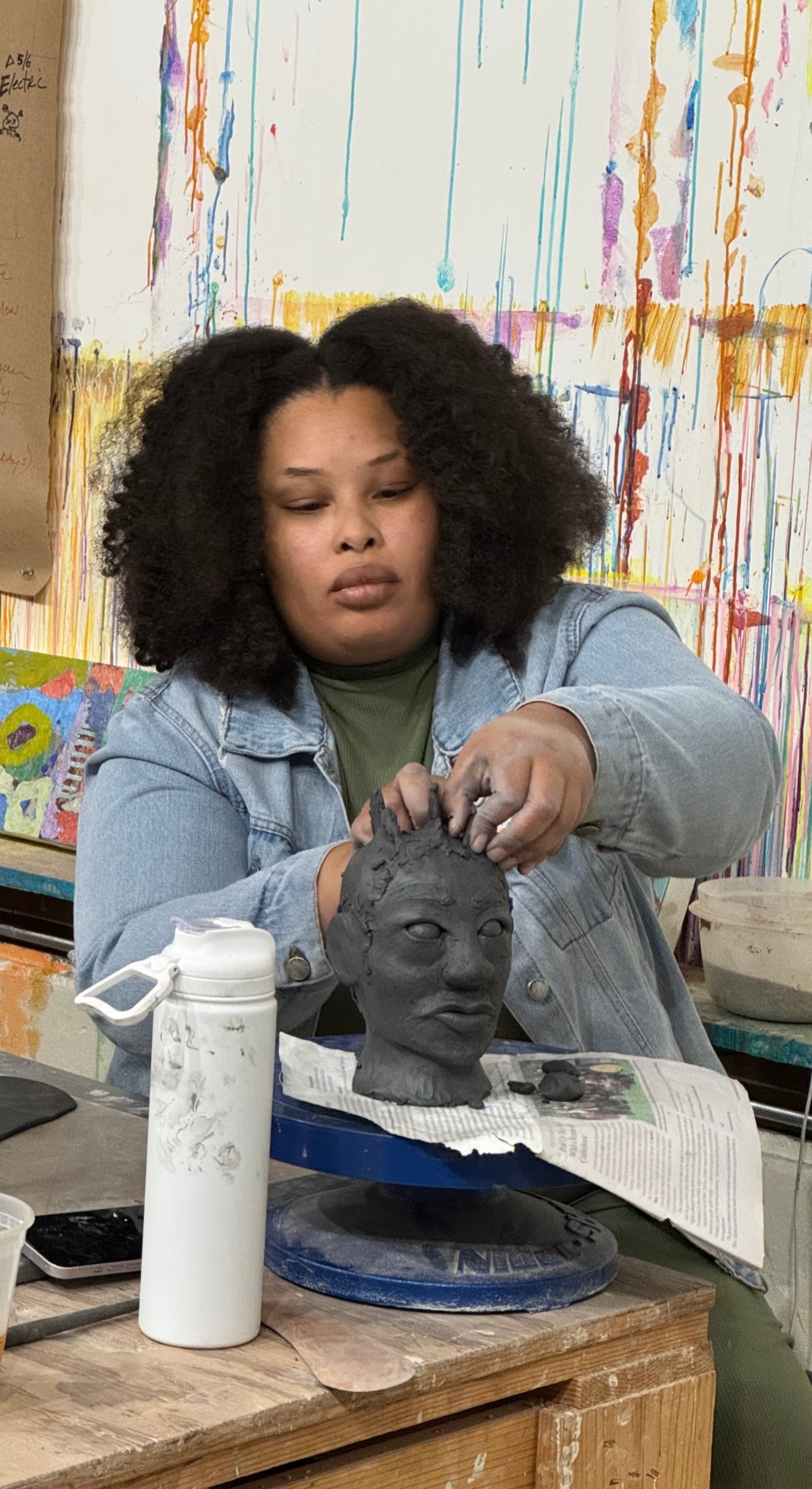
The very first time I touched clay, it stopped being a workshop activity. By the end of my first workshop at The Bottom, I was already asking the instructor how I could keep working once I got home. They sent me home with some clay and a basic set of tools.
I dragged my kitchen table into the living room and spent the next two days making nonstop. Sitting there, sculpting forms that had lived as persistent visions in my mind and finally giving them physical form, the experience felt deeply spiritual. I haven’t really put the clay down since. As someone who has always been a serial hobbyist, that says a lot.
Ty Murray
What kind of conversation are you having with the material these days?
Jazzmine Curtis
Lately, my conversation with clay has been about refuge.
We are living through a time marked by violence, uncertainty, and the erosion of rights. I often arrive in the studio carrying the weight of those realities. The moment I sink my hands into the firm yet yielding clay, I feel held by the material. It’s not asking anything of me except that I be present. It’s a place where what is hard to articulate can exist without needing to be resolved.
What I’m exploring now is whether that experience can live within the work itself. How does Clay embody refuge without complete alienation and escape? Can an object hold someone emotionally the way a sanctuary holds a body? I’m interested in whether a vessel or a figure can offer shelter not from the reality of our world, but from despair.
Ty Murray
Are there ceramic artists, historical or contemporary, whose work has shaped your own practice?
Jazzmine Curtis
There are so many artists whose work continues to inspire me and shape my practice, both within and beyond ceramics. Black figurative sculptors like Elizabeth Catlett, Augusta Savage, Edmonia Lewis, Simone Leigh, Vanessa German, and Selma Burke have deeply influenced the way I think about the Black figure as a site of memory, dignity, and power. Magdalene Odundo’s vessels have expanded my understanding of what clay can communicate through form alone.
Closer to home, I’ve been shaped by artists whose impact extends beyond their objects. Although I never met Sammie Nicely, I’ve come to know his legacy through the stories of Knoxville artists and community members. What stays with me is not only his ceramics but the relationships he cultivated. He made his work accessible and remained deeply connected to his community. That has influenced how I hope to show up as an artist, not just through the work I make, but through the community I help build.
Bessie Harvey has also been a profound influence. Growing up in East Tennessee, I encountered her name and work long before I understood their significance. Returning to her work as an adult, I was struck by her ability to transform found materials into figures that feel both divine and deeply familiar. There is an incredible confidence in her work. It doesn’t feel performative or self-conscious. It simply is. That unwavering sense of purpose has stayed with me.
Ty Murray
Has being in community with other Black ceramic artists influenced the direction of your work?
Jazzmine Curtis
Absolutely. My work is very Black. What I mean by that is my work pulls directly from my ancestral and cultural heritage as an African American. I’ve received critiques suggesting that because my work is so visually Black, it is niche or could be alienating.
Being in community with Black ceramic artists has allowed me to witness the expansiveness of Blackness and the Black experience. That affirms for me that being rooted in my identity is not a limitation; it is anything but limiting.
Ty Murray
What clay body feels most like "home" to you right now? What do you love about it?
Jazzmine Curtis
Ha! You would ask this. You could call me a clay nomad; I jump from clay body to clay body and never stay “home” too long.
I’ve always been drawn to rich reds, dark browns, and black clays. Standard 266 is a favorite of mine. It’s a beautiful dark brown, really smooth, and when it’s fired to cone 6, it goes almost black. It’s just a gorgeous material to work with on and off the wheel.
Since starting my residency at the University of Tennessee, I’ve been working with their sculpture body that’s mostly Red Art clay. It has more grog than I’m used to, but that has actually been a gift; it’s strong and has allowed me to scale my work up in a way I couldn’t before. I also love the way it fires: a deep reddish brown at cone 6 that feels alive.
The last one I’m thinking about is Ironstone from New Mexico Clay. I got to work with it briefly while I was in New Mexico and completely fell in love with it. It’s a cone 6 stoneware, very dark, and I love that the undertone isn’t too warm. It’s beautiful to throw and handbuild with. If I were further west, that would probably be my go-to clay right now.
Ty Murray
You move between wheel-thrown forms and sculpture. What does each process allow you to express?
 Jazzmine Curtis
When I am throwing, I am working in a more left-brain-heavy space. I am planning, thinking intentionally about weight, ratios, and angles, and paying close attention to how each choice affects the form as it rises on the wheel. There is a kind of structure and problem-solving in that practice that feels very different to me, and I am especially aware of it when I am at the wheel.
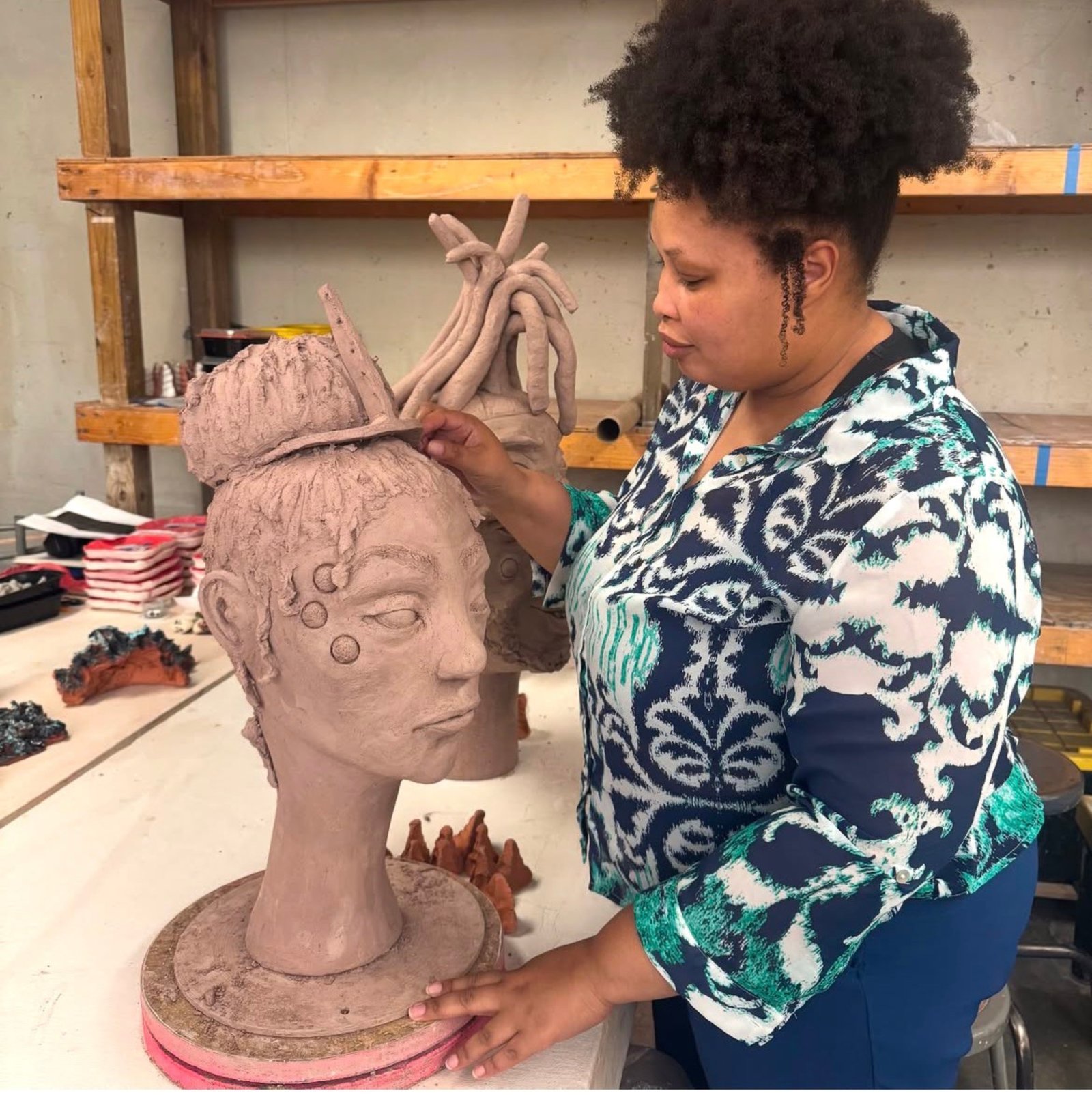
When I am handbuilding, I move into a more meditative state. I may come with a vision, but I try to clear my mind and open myself to my ancestral guides, as well as to the spirit of the clay itself. That process feels slower and more intuitive, and I often find myself listening as much as shaping. It is a space where I can respond to what the material wants to do, rather than trying to control every outcome.
Ty Murray
When do you know a piece needs to be thrown versus hand-built?
Jazzmine Curtis
I know a piece needs to be thrown when the form requires precision, repetition, or a sense of engineered structure. If I am thinking about symmetry, weight distribution, or a vessel that needs to hold in a very specific way, I go to the wheel.
I know a piece needs to be hand-built when the idea is more emotional, narrative, or sculptural in nature. If I need to follow intuition, build slowly, or allow the form to shift as it develops, I work by hand. Those are the moments when the piece feels like it is being discovered rather than planned.
Ty Murray
Since beginning with ceramics, have you found any techniques that have transformed your work the most over the last few years?
Jazzmine Curtis
Wax resist, stamps, and sprig molds are three techniques I find myself coming back to over and over again. I’ve realized it’s really the act of mark-making that pulls me toward them. No matter how my work shifts, a central thread has always been storytelling, history, and the griot tradition. These techniques give me a way to physically leave my mark, my story, embedding a script that I created into the surface of the work.
Ty Murray
What are you currently researching or experimenting with in the studio?
 Jazzmine Curtis
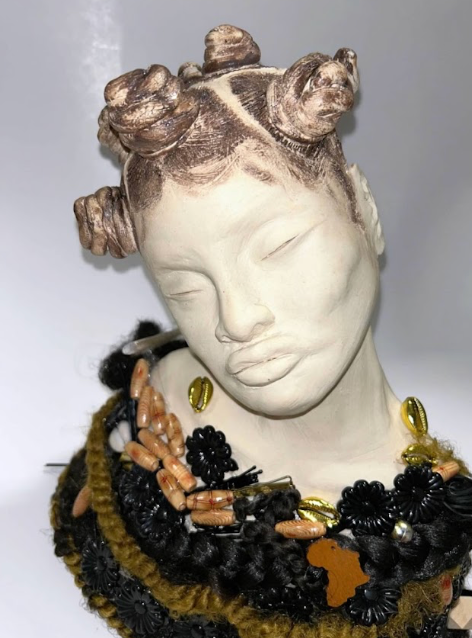
I’ve started researching the Great Dismal Swamp. Today, it’s a wildlife refuge in southeast Virginia and northeastern North Carolina, but historically it was also a sanctuary for thousands of Africans who escaped enslavement. The swamp’s landscape was harsh and difficult to navigate, yet a large community of marooned Africans adapted and lived there mostly undisturbed until the final communities disbanded sometime after the Civil War in the 1860s.
Right now I’m reading Brent D. Morris’ Dismal Freedom: A History of the Maroons of the Great Dismal Swamp myself and Freewater by Amina Luqman-Dawson with my children. This research is a continuation of the conversations I’ve been having with my material lately. What does the sense of refuge I feel when I’m working with clay look like in the work?
I’m excited to see how this begins to show up in the work and how I answer that question.
Ty Murray
When introducing someone to clay for the first time, what's the first lesson you hope they learn?
Jazzmine Curtis
You are playing in mud, lighten up!
That is the most liberating lesson I’ve learned and return to. Constantly grounding in this lesson allows me to pack away perfection paralysis and truly play, explore, question, and connect to child-like wonder.
It is in this explorative play and risk-taking that I have uncovered compelling ideas that I ultimately experimented with seriously. It is during the play that I received the most material feedback and learning. It really is being comfortable enough to color outside the lines that has helped me grow the most in my practice.
Ty Murray
Your work often references Gullah Geechee culture, African diasporic symbols, and ancestral lineage. How do you decide which stories belong in a piece?
Jazzmine Curtis
Deciding what references appear in my work is part scholarship, part spiritual practice. I practice ancestral veneration. As a part of ancestral veneration, through rites and rituals, I communicate with my ancestors and familial spirit guides. I ask them for guidance in my life, but also for help understanding my history, lineage, and identity with more clarity.
Using what I receive through divination, I then work to research and connect the academic dots to what I’ve been given spiritually. I dig into archives and literature on the subjects, themes, and imagery that come through.
I don’t plan every detail of the imagery in the work. It’s become part of me, my psyche, and my spiritual practice, so it tends to surface naturally in what I make.
Ty Murray
How do you balance honoring tradition while also developing your own visual language?
Jazzmine Curtis
I’ve got to admit, I haven’t thought about this too deeply in a structured way. From the very first piece I made, I’ve just been trying to pour out what my creative self has to offer. What comes out never feels like reproduction or something too closely referenced.
Ty Murray
You recently took part in a clay mentorship. How was that experience for you?
Jazzmine Curtis
Within the past six months, I closed out two really impactful mentorships. The first was with Cohort.Arts under the mentorship of Sam Harvey. I had the opportunity to engage with a cohort of five other ceramic artists. We all had different styles, were at different points in our careers, and came from different backgrounds and places. That made for a really dynamic group with a wide range of knowledge and expertise.
We met monthly as a group and more frequently one-on-one. That structure pushed me to prioritize my practice, develop my work in ways I had struggled to do on my own, and push past technical limitations with the support of the cohort. It stretched me in really meaningful ways and helped my work grow tremendously. I would recommend this kind of experience to anyone at any stage of their ceramic practice, professional or not. The community alone is invaluable.
I was also fortunate enough to be accepted into The Color Network mentorship program. To give a bit of context, The Color Network was founded in 1991 by Bobby Scroggins, such a dope human, to create spaces and opportunities for Black artists to connect and be in community. It was expanded in 2018 and is still going strong through the dedication of so many people. One of its initiatives is an international mentorship program that pairs POC mentor/mentee pairs to work together over six months.
I had the privilege of working with Professor Tia Santana. That mentorship opened up really deep, inquiry-based conversations that pushed me to think about my work in ways I hadn’t considered before. It also helped me prepare for my first academic artist talk as the local artist in residence at the University of Tennessee, Knoxville.
When I used to think of artists, I pictured a lone wolf in a studio, head down, furrowed brow, working away without looking up. While I know that is the reality for some, in my journey and practice that is not always the case. It has been filled with community, mentorship, and connection, and I am deeply grateful for that.
Ty Murray
Do you feel represented in conversations about contemporary ceramics? Why or why not?
Jazzmine Curtis
I think being connected to organizations that continue to work with organizers and artists doing the work to ensure equity in art allows me to feel supported and represented, especially within my micro-community. However, in the larger conversation, there is definitely still work to be done. Women and artists of color continue to be underrepresented in institutional galleries. Black women artists account for only about 0.5%, some sources say 3%, of total museum acquisitions. That has to change.
This goes back again to how stories are told and whose stories are centered, overlooked, or erased.
Ty Murray
How has your experience as an NCECA Multicultural Fellow influenced your journey with ceramics?
Jazzmine Curtis
It has allowed me to see the possibilities of being an artist in ceramics. It has helped me dream bigger. Through the Multicultural Fellowship, it connected me to community and opportunities at NCECA that I might not have otherwise had access to.
I’ve made deep relationships that have come from conversations, knowledge-sharing, and simply hearing about other people’s experiences. Those connections have directly supported my growth, leading to fellowships, scholarships, mentorships, and exhibitions.
More than anything, the Multicultural Fellowship has been a real gift to my spirit. Being surrounded by so many people from all over the world who are able to center and celebrate their culture through their work is incredibly powerful. It’s a beautiful thing to witness and be part of.
Ty Murray
What risks are you excited to take in your practice?
Jazzmine Curtis
My mentor and friend is building a wood kiln, and I’m really excited about having access to that kind of firing and deepening my knowledge of woodfiring. I’m especially excited to experiment with resists in a wood kiln using refractory materials and atmosphere, instead of wax and glaze like I do now in cone 6 oxidation.
One thing I’ve learned about ceramics is that the possibilities and the questions are endless.
Ty Murray
What's a lesson clay taught you that you wouldn’t have learned any other way?
 Jazzmine Curtis
Clay has taught me to stay in relationship with uncertainty and keep going anyway. Learning that nothing in the process is fully “under control”. Even when I plan, test, and prepare, clay will still do what it wants sometimes. It cracks, shifts, or responds in ways I didn’t expect.
At first that used to frustrate me, but over time it’s become one of the most important lessons in my practice. It’s taught me patience, resilience, and a kind of trust in the beauty of co-creation. I’ve learned not to abandon a piece or myself when things don’t go as planned, but to stay with it, adjust, and keep moving. Of course, this is something that I’ve carried into my life outside of clay.
Ty Murray
What does it mean to you to be an “Afrolachian” artist working in clay right now?
Jazzmine Curtis
To me, being an Afrolachian artist means taking up the mantle and continuing the work of the Black artists who came before me in Appalachia. It means insisting that our stories, our histories, and our creativity have always been part of this region, even when they’ve been left out of the narrative.
For as long as I can remember, Appalachia has been imagined as white, and Black people have been pushed to the margins of that identity. But we’re Appalachia too. We’ve always been here. We’ve worked this land, built communities, made art, carried traditions, and shaped the culture of this place, even when history didn’t acknowledge it. The term “Affrilachia/Afrolachian” itself was created to push back against that erasure and make Black Appalachians visible.